
Introduction
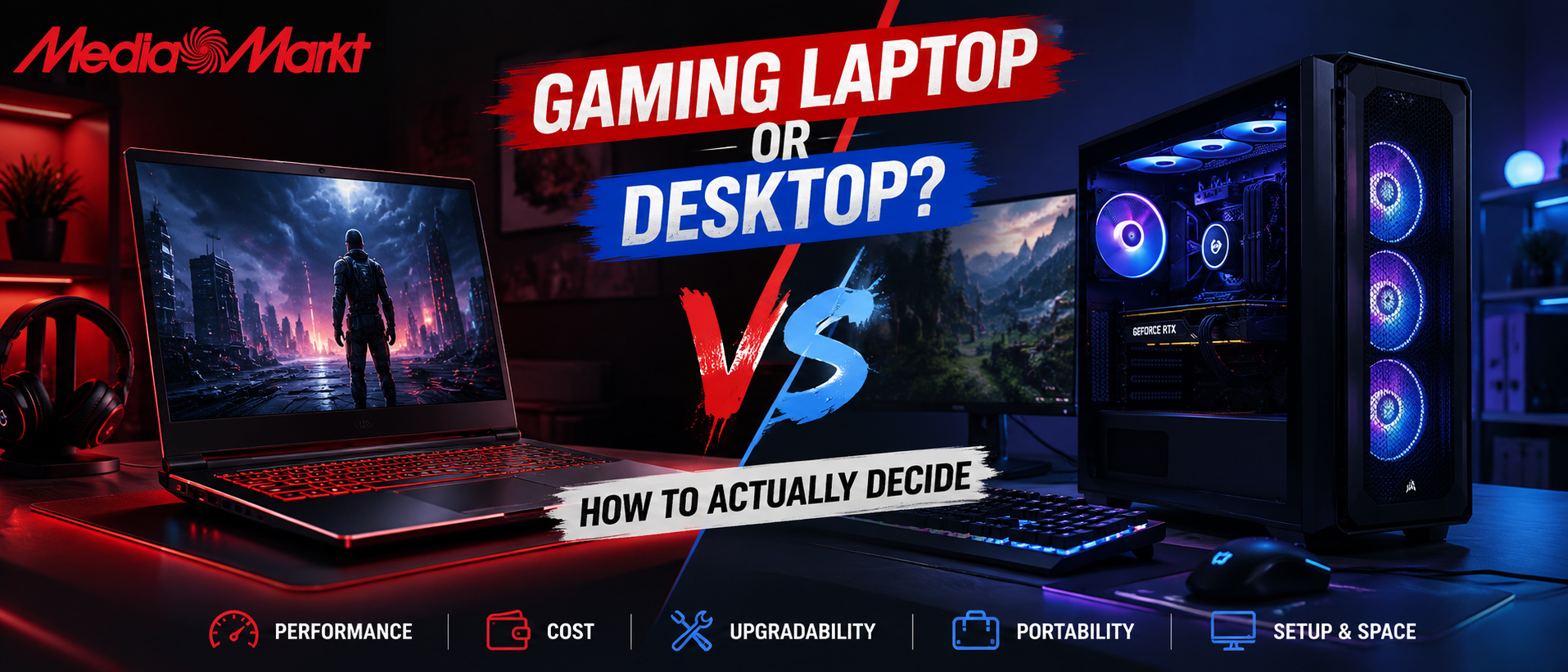
🎮 Choose Your Rig!So you're standing at the crossroads. On one side, a sleek gaming laptop calling your name. On the other, a beastly desktop tower promising raw, unfiltered power. The gaming laptop or desktop debate has been going on for years, and honestly, it's not getting any simpler. New GPUs drop every year, laptops keep getting thinner (somehow still powerful), and desktops just keep flexing on price-to-performance charts. So which one is actually right for you? Let's break it down properly, no fluff, no nonsense. Looking for the right gaming laptop or desktop? MediaMarkt offers a wide range of gaming devices and tech to help you find the setup that fits your needs.
Gaming Laptop or Desktop: What's the Real Question?
Before you scroll through another "top 10 gaming laptops" list, pause for a second. The gaming laptop or desktop decision isn't really about which machine is "better" in some abstract, universal sense. It's about your life. Where do you play? Who else uses the space? Do you move around a lot, or is your setup basically glued to one desk?Think about it this way. A desktop is a commitment to a spot. A laptop is a commitment to flexibility. Once you frame it like that, the whole decision gets a little less overwhelming.
There's also the budget question, which we'll get into properly in a bit. And the upgrade question. And the "will this still run new games in three years" question. Lots of angles here, so let's go through them one at a time.
Gaming Laptop Advantages You Shouldn't Ignore
Let's start with the laptop side, because honestly, people underestimate it more than they should.Portability that actually matters. This is the obvious one, but it's obvious for a reason. Got a LAN party with friends? Traveling for work but still want to squeeze in a few hours of gaming at night? Living in a small apartment where a full desktop rig just doesn't fit? A gaming laptop solves all of that in one shot. You close the lid, you're done. No cable management, no separate monitor, no fuss.
One device, many roles. A lot of gamers, especially students, need something that can also handle assignments, video calls, spreadsheets, whatever. A gaming laptop lets you do all that without owning two separate machines. That's a genuinely underrated perk.
Built-in everything. Screen, keyboard, speakers, webcam, battery. It's all there. You're not shopping for five separate peripherals and hoping they match aesthetically (though let's be real, RGB syncing is its own hobby at this point).
Modern laptops are stronger than you'd think. The gap between laptop and desktop performance has actually narrowed over the last few years. High-end gaming laptops now pack serious GPUs that can handle demanding titles at solid frame rates, even if they're not quite matching a top-tier desktop card watt for watt.
That said, laptops aren't perfect. Thermal limits are real. A laptop GPU is usually a slightly toned-down version of its desktop equivalent, tuned to fit inside a chassis that also needs to stay cool and, ideally, not sound like a jet engine taking off. It's a trade-off. Always has been.
Gaming Desktop Cost: What You're Really Paying For
Now here's where things get interesting, because gaming desktop cost is one of those topics that sounds simple until you actually start pricing parts.On paper, desktops usually win the price-to-performance argument. Dollar for dollar (or euro for euro), you get more raw power from a desktop than a laptop with similar specs. Why? Because desktop components don't need to be miniaturized, don't need to sip power to preserve battery life, and don't need fancy cooling engineering crammed into a two-centimeter-thick shell. A big case with proper airflow is just... easier to build cheap performance into.
But "cheaper" doesn't always mean "cheap." A capable gaming desktop with a mid-range GPU, decent CPU, enough RAM, and a good power supply still adds up. Then you've got the monitor. And the keyboard. And the mouse. And maybe speakers or a headset. Suddenly your "affordable" desktop build isn't looking quite so affordable once you tally the whole setup.
There's also the hidden cost of time. Building your own desktop, or even just picking and assembling pre-chosen parts, takes research, patience, and a little bit of troubleshooting nerve. Not everyone wants that. Some people just want to open a box, plug it in, and play.
Still, if long-term value is your priority, desktops tend to age better financially. You can upgrade a graphics card in a few years without replacing the whole machine. Try doing that with a laptop.
Is a Gaming Laptop Better Than a Desktop? It Depends on This
Everyone wants a simple yes or no here, but is a gaming laptop better than a desktop really doesn't have a single answer. It depends on what "better" means to you.Better for performance per euro spent? Desktop, generally. Better for flexibility and space-saving? Laptop, no contest. Better for upgrading down the line? Desktop, easily. Better for someone who studies, works, and games from the same device? Laptop, again.
See the pattern? It's not really about which machine is objectively superior. It's about matching the machine to the person using it.
If you're someone who plays competitive shooters at max settings and cares deeply about squeezing out every extra frame per second, a desktop is probably going to serve you better long term. Desktops handle heat more gracefully, which means sustained performance during long sessions without throttling.
If you're someone who wants a decent gaming experience without being tied to one room, or you split your time between gaming, schoolwork, and general use, the laptop starts making a lot more sense. And modern gaming laptops, especially the ones with good cooling systems and higher refresh rate screens, really do deliver a satisfying experience.
Gaming Laptop Portability: The Deciding Factor for Many
Let's talk about gaming laptop portability a bit more, because for a lot of buyers, this single factor ends up deciding the whole thing.Portability isn't just about carrying your PC to a friend's house once a month. It's about lifestyle. Students moving between dorm rooms and lecture halls. People who travel often for work but still want their evenings to include some gaming. Families who share limited living space and can't dedicate a permanent desk setup to one person's hobby.
A laptop folds all of that complexity away. You get your games, your saves, your settings, all bundled into something you can slide into a bag. No re-setting-up cables, no moving a monitor, none of that.
Of course, portability comes with trade-offs. Battery life during actual gaming (not just browsing) tends to be short, often under two hours on demanding titles, since high-performance components drain power fast. Most people end up gaming plugged in anyway, which slightly undercuts the "take it anywhere" appeal, but even so, the ability to unplug and go is still there when you need it.
Noise, Heat, and Everyday Maintenance
Nobody really talks about this part enough, but it matters more than people expect once the new-gadget excitement wears off.Desktops, thanks to their larger cases, generally run cooler and quieter under load. Bigger fans can spin slower while moving the same amount of air, which means less whining noise during an intense gaming session. There's also more room for dust filters and easier cleaning. Popping open a case, blowing out dust every few months, swapping a thermal paste job here and there, it's all fairly manageable.
Laptops, on the other hand, pack all those same components into a tight, compact shell. That means smaller fans working harder, which usually translates into more noise under heavy load. Dust builds up in tighter spaces too, and cleaning a laptop properly often means partial disassembly, which isn't exactly beginner-friendly. Some gamers just live with the noise. Others invest in a cooling pad, which helps a little, though it's not a magic fix.
None of this is a dealbreaker either way. It's just one of those quieter (pun intended) factors that shapes day-to-day comfort, especially if you're gaming late at night while someone else is asleep in the next room.
Upgrade Paths and Longevity
This ties back into gaming desktop cost, but it deserves its own moment.With a desktop, when a new generation of graphics cards releases and your current one starts feeling dated, you can simply swap it out. Same goes for RAM, storage, even the motherboard if you're feeling ambitious. The core investment, the case, the power supply, often the CPU cooler, can stick around for years while individual parts get refreshed.
Laptops don't offer that same freedom. Most gaming laptops let you upgrade RAM and storage, sometimes both, sometimes just one. But the GPU and CPU are typically soldered in or otherwise locked to the chassis. Once those start falling behind, your options are limited to living with reduced settings or buying a whole new machine.
This is worth sitting with for a moment if you're the type who likes squeezing five, six, seven years out of a system. Desktops are simply built for that kind of longevity in a way laptops usually aren't.
Should I Buy a Gaming Laptop or Desktop? A Quick Decision Guide
- If you're still torn, ask yourself these questions. Answering them honestly usually clears things up fast.
- Do you need to move your setup often, whether between rooms, cities, or countries? If yes, lean laptop.
- Is squeezing the absolute maximum performance out of your budget your top priority? If yes, lean desktop.
- Do you want a single device for gaming, studying, and general work? The Laptop tends to fit better here.
- Are you planning to upgrade individual components over the next few years instead of replacing the whole system? Desktop wins that one.
Should I buy a gaming laptop or desktop isn't a question with a universal right answer. It's a question only you can answer, based on how you actually live and play, not based on what looks impressive in a spec sheet.
Final Thoughts
At the end of the day, the gaming laptop or desktop decision isn't about chasing the most powerful machine on paper. It's about picking the setup that actually fits into your life without friction. If you value freedom of movement and a single device that handles everything from essays to esports, a laptop earns its price tag. If you're chasing top-tier performance, long-term upgrade flexibility, and better value for every unit of computing power, a desktop is hard to beat. Take stock of your space, your budget, your habits, and let those answers guide you rather than trends or hype. Whichever path you choose, gaming laptop or desktop, the right pick is simply the one that fits how you actually want to play. For gaming laptops, desktops, and other tech essentials, check out MediaMarkt for a wide range of options to build your ideal gaming setup.🎮 Choose Your Rig!
Explore Newsbuck for more exclusive deals and important updates. We are your go-to source for all the news and trending stories across fashion, politics, health, entertainment and much more!
FAQs
1. Is a gaming laptop better than a desktop for competitive gaming?
Not usually. Desktops handle sustained high performance better because of superior cooling, which matters a lot during long competitive sessions. Laptops can still perform well, but they're more prone to thermal throttling over extended play.
2. Does gaming desktop cost really work out cheaper in the long run?
Often, yes. While the upfront cost of a full desktop setup with peripherals can be similar to a laptop, desktops allow you to upgrade individual parts like the GPU or RAM over time instead of replacing the entire system.
3. How much does gaming laptop portability actually matter for casual gamers?
It depends on your lifestyle. If you rarely move your setup and always game from the same spot, portability might not matter much. But if you travel, study away from home, or share living space, it can be a genuinely deciding factor.