
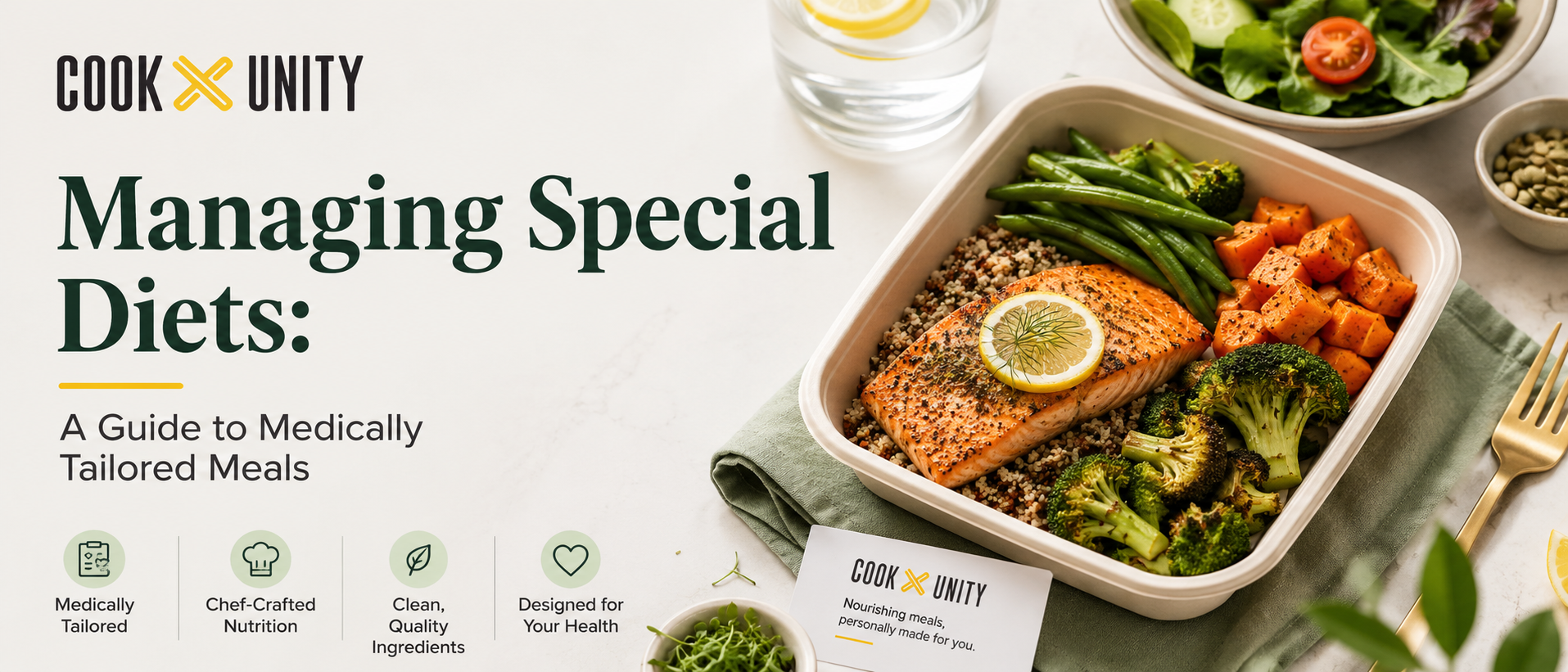
Overview
Okay, so eating healthy sounds simple, right? Just… eat less junk. Drink more water. Done. Except it's not. Not even close. Especially when you or someone you love has a medical condition that turns every grocery run into a research project. Special diet management is one of those things that sounds very clinical and boring until it's suddenly your whole life.At Cook Unity we work with chefs and nutrition-forward thinkers every single day—and what have we learned? Food is personal. Like, deeply personal. A diabetic meal plan that works beautifully for one person might feel like a punishment to someone else. A heart-healthy diet plan might need to coexist with gluten-free diet foods—and suddenly the list of what you can eat shrinks dramatically. It's a lot.
This guide is for anyone navigating that complexity. Whether you're managing your own special diet, cooking for a family member, or just trying to understand what "medically tailored meals" actually means—we've got you.
What Exactly Is a Special Diet, Anyway?
Let's clear something up first. A special diet isn't a trend. It's not a 30-day challenge or something you saw on Instagram. It's a way of eating specifically structured around a health condition—recommended (or required) by a doctor, dietitian, or both.Some common examples:
- Diabetic meal plans for managing blood sugar
- Heart-healthy diet plans for reducing cardiovascular risk
- Low-sodium diet plans for people with hypertension or kidney disease
- Gluten-free diet foods for those with celiac disease or gluten sensitivity
The Diabetic Meal Plan
People hear "diabetic diet" and immediately think it means no birthday cake, no fruit, no joy. That's not quite right — and it's actually kind of frustrating how often that misconception floats around.A diabetic meal plan is really about controlling when and how much carbohydrate you eat, not eliminating entire food groups. The goal is keeping blood glucose levels stable—not spiking, not crashing.
That means:
- Prioritizing complex carbohydrates like whole grains, legumes, and vegetables over refined ones
- Eating at regular intervals—skipping meals can cause blood sugar dips that are genuinely dangerous.
- Balancing every plate with protein, healthy fat, and fiber to slow glucose absorption
Cook Unity's chef-crafted meals take this seriously. Each dish is designed with macronutrient balance in mind. You're not just picking something that sounds healthy — you're eating something that is calibrated.
Heart-Healthy Diet Plan: Eating for Your Most Important Muscle
Your heart works constantly. Like, every second of every day, without a break. The least you can do is feed it well, right?A heart-healthy diet plan focuses on reducing things that contribute to arterial plaque, inflammation, and high blood pressure. Saturated fat, trans fat, excessive sodium — these are the usual suspects. What you add matters just as much as what you cut.
Foods that genuinely support heart health:
- Fatty fish like salmon, mackerel, and sardines (rich in omega-3s)
- Nuts and seeds—a handful of walnuts a day has actual clinical backing
- Leafy greens—spinach, kale, arugula…the darker the better.
- Whole grains — oats, brown rice, quinoa
- Olive oil- over butter or margarine, always.
The hard part? A lot of heart-healthy cooking feels bland compared to what most of us grew up eating. Reduced fat, reduced salt, reduced flavor—that's the assumption. But it doesn't have to be. Good technique, quality ingredients, and the right seasoning (herbs, citrus, aromatics) can make heart-conscious cooking genuinely delicious.
That's exactly what Cook Unity chefs focus on. Nobody should feel like they're being punished for taking care of themselves.
Low Sodium Diet Plan: The Hidden Salt Problem
Here's something that blew my mind when I first learned it: most Americans consume roughly 3,400 mg of sodium per day. The recommended limit for someone on a low-sodium diet plan is typically 1,500–2,000 mg per day. That gap is enormous. And what's worse, most of that excess sodium doesn't come from the salt shaker on your table.It comes from packaged food. Canned soups. Deli meats. Bread. Cheese. Things you'd never suspect.
A low sodium diet is essential for people managing the following:
- Hypertension (high blood pressure)
- Heart failure
- Chronic kidney disease
- Liver conditions
Practical swaps that actually help:
- Choose fresh or frozen vegetables over canned ones (or rinse canned ones thoroughly)
- Use herbs, spices, lemon juice, and vinegar to add flavor without salt.
- Look for "no salt added" versions of pantry staples.
- Cook at home more—restaurant food is typically very high in sodium
Gluten-Free Diet Foods: Necessity Versus Trend
Gluten-free eating has become… a lot. It's trendy. It's been co-opted. And that's created a genuinely confusing environment for people who actually need to avoid gluten—people with celiac disease, non-celiac gluten sensitivity, or wheat allergy.For those individuals, cross-contamination is a real concern. Shared cooking surfaces, shared utensils, and even shared toasters can cause problems. It's not fussy. It's physiology.
Foods naturally free of gluten:
- Rice, quinoa, millet, buckwheat
- All fresh fruits and vegetables
- Fresh, unprocessed meat and fish
- Eggs, most dairy
- Legumes and most nuts
- Processed foods (often contain hidden gluten as a thickener or filler)
- Soy sauce (typically wheat-based — tamari is the safe swap)
- Oats (naturally gluten-free but frequently cross-contaminated)
- Beer, malt beverages
When Special Diets Overlap: Managing Multiple Restrictions
This is where things get real. Because it's not always one condition, one diet. Sometimes it's two or three layered on top of each other, and the Venn diagram of "foods you can eat" starts feeling dangerously small.A few common overlapping scenarios:
- Diabetic + Heart Healthy: Focus on foods that are high-fiber, low-glycemic, and low in saturated fat simultaneously. Think: grilled salmon with roasted vegetables and brown rice. Simple, but it checks a lot of boxes.
- Heart Healthy + Low Sodium: Most heart-healthy guidance already incorporates sodium reduction, so these two align fairly naturally. The challenge is flavor—building depth without salt requires real skill.
- Gluten-Free + Diabetic: Many naturally gluten-free grains are actually great for blood sugar management (quinoa, buckwheat). But gluten-free processed products can be high in refined starches that spike glucose. Real food over packaged alternatives matters even more here.
How Cook Unity Approaches Medically Tailored Meals
Cook Unity isn't a diet company. It's a chef-driven meal-delivery platform—but one that takes nutritional integrity seriously. Each meal is crafted by an independent chef and then nutritionally vetted. That means:- Transparent ingredient lists and macros on every dish
- Filter options to sort by dietary needs (low sodium, gluten-free, diabetic-friendly, etc.)
- Real restaurant-quality food that doesn't taste like a compromise
- The medically tailored meal space has historically felt… clinical. Sad. Like eating a beige tray of something that's technically nutritious but emotionally deflating. Cook Unity pushes back on that. Food should be something you look forward to, even—especially—when you're managing a health condition.
Practical Tips for Managing Your Special Diet Day to Day
Even with a great meal service, you're still making choices throughout the week. A few things that genuinely help:Plan ahead, even loosely. You don't need a rigid meal plan, but knowing what you're eating tomorrow prevents last-minute decisions that tend to undermine dietary goals.
Batch cook what you can. Grains, roasted vegetables, hard-boiled eggs — things that sit in the fridge and become building blocks for quick meals.
Find your flavor anchors. What makes food feel satisfying to you? For some people it's hot. For others it's umami, or acid, or something crunchy. Build your diet around those sensory anchors and you're far more likely to enjoy eating within your restrictions.
Don't catastrophize slip-ups. One meal off-plan doesn't derail your health. What matters is the consistent pattern over weeks and months, not any single day.
Use labels as tools, not obstacles. Understanding how to read a nutrition label takes about 20 minutes to learn properly. That knowledge compounds—every trip to the grocery store gets faster and smarter.
Final Thoughts
Managing a special diet can feel overwhelming at first. Like the world was built for people who can eat everything, and you have to navigate it with a different map. That feeling is valid. And it's also temporary—because once you find your footing, once you know your options, your go-to meals, and the shortcuts that work for your life, it becomes just… how you eat.A diabetic meal plan, a heart-healthy diet plan, a low-sodium diet plan, a gluten-free approach—these aren't punishments. They're tools. Strategies for living longer, feeling better, and staying out of situations that are way harder to manage than switching to olive oil and fresh herbs.
At Cook Unity, we believe that special diet management should come with real, delicious food—not trade-offs. If you're navigating any of this, we'd love to make the food part easier. Because you've already got enough to manage.
🩺 Support Your Wellness
Explore Newsbuck for more exclusive deals and important updates. We are your go-to source for all the news and trending stories across fashion, politics, health, entertainment and much more!
FAQs
Q1. What is a medically tailored meal, and how is it different from a regular meal delivery?
A medically tailored meal is designed around a specific health condition — such as diabetes, heart disease, or kidney issues — with controlled macronutrients, sodium, and ingredients. Unlike standard meal delivery, every dish is nutritionally calibrated, not just "healthy in general."
Q2. Can I follow a diabetic meal plan and a gluten-free diet at the same time?
Yes — and it's more manageable than it sounds. Many naturally gluten-free grains like quinoa and buckwheat are also low-glycemic, making them great for blood sugar control. The key is focusing on whole, unprocessed foods and avoiding packaged gluten-free products that can be high in refined starches.
Q3. How much sodium is considered "low" on a low sodium diet plan?
Most low sodium diet plans recommend staying between 1,500–2,000 mg of sodium per day. For context, the average American consumes around 3,400 mg daily. The biggest sources are usually packaged and restaurant foods — not the salt shaker at the table.
Q4. Is a heart healthy diet plan the same as a low-fat diet?
Not exactly. A heart healthy diet plan focuses on reducing saturated and trans fats while actively including beneficial fats — like those from olive oil, fatty fish, nuts, and avocado. It's less about cutting all fat and more about replacing harmful fats with heart-supportive ones, alongside plenty of fiber-rich vegetables, whole grains, and lean protein.