
Introduction
📈 Earn MorePicture two freelancers. Both are equally skilled. Both finish a logo design project in six hours. One bills $50 an hour and walks away with $300. The other priced the project at $2,000 because the client's brand refresh was tied to a product launch worth six figures. Same skill. Same hours. Wildly different paycheck. That's the entire argument for value-based pricing in a single example, and it's why so many freelancers, agencies, and consultants are quietly rethinking how they charge for their work. Whether you're finding clients independently or through platforms like Fiverr, choosing the right pricing strategy can make a significant difference in your earnings.
This isn't another "raise your rates" pep talk. It's a practical look at why hourly billing quietly caps your income, what value-based pricing actually means (it's more nuanced than "charge more"), and how you can shift your pricing model without scaring off good clients.
The Real Problem With Hourly Rates
Hourly billing feels safe. You track time, multiply by your rate, and send an invoice. Simple. Except it has a built-in flaw that most people don't notice until years into their freelance or agency career: it punishes you for getting better at your job.Think about it. The faster and more skilled you become, the fewer hours a project takes — and the less you earn. A copywriter who used to take ten hours to write a sales page might now do it in three, thanks to experience. Under hourly billing, that growth in skill literally shrinks the invoice. That's backwards. Clients aren't paying for your time, not really. They're paying for the outcome — more leads, more conversions, a brand that finally looks credible. Time is just the unit we've defaulted to because it's easy to measure, not because it reflects actual worth.
There's also the trust issue. Clients increasingly view time-tracking and hourly billing with suspicion. Are you working efficiently, or padding the clock? Even when you're completely honest, the hourly model creates a built-in incentive misalignment that smart clients can sense. It's one reason why so many service-based businesses are moving toward project-based pricing and outcome-driven contracts instead.
What Is Value-Based Pricing, Really?
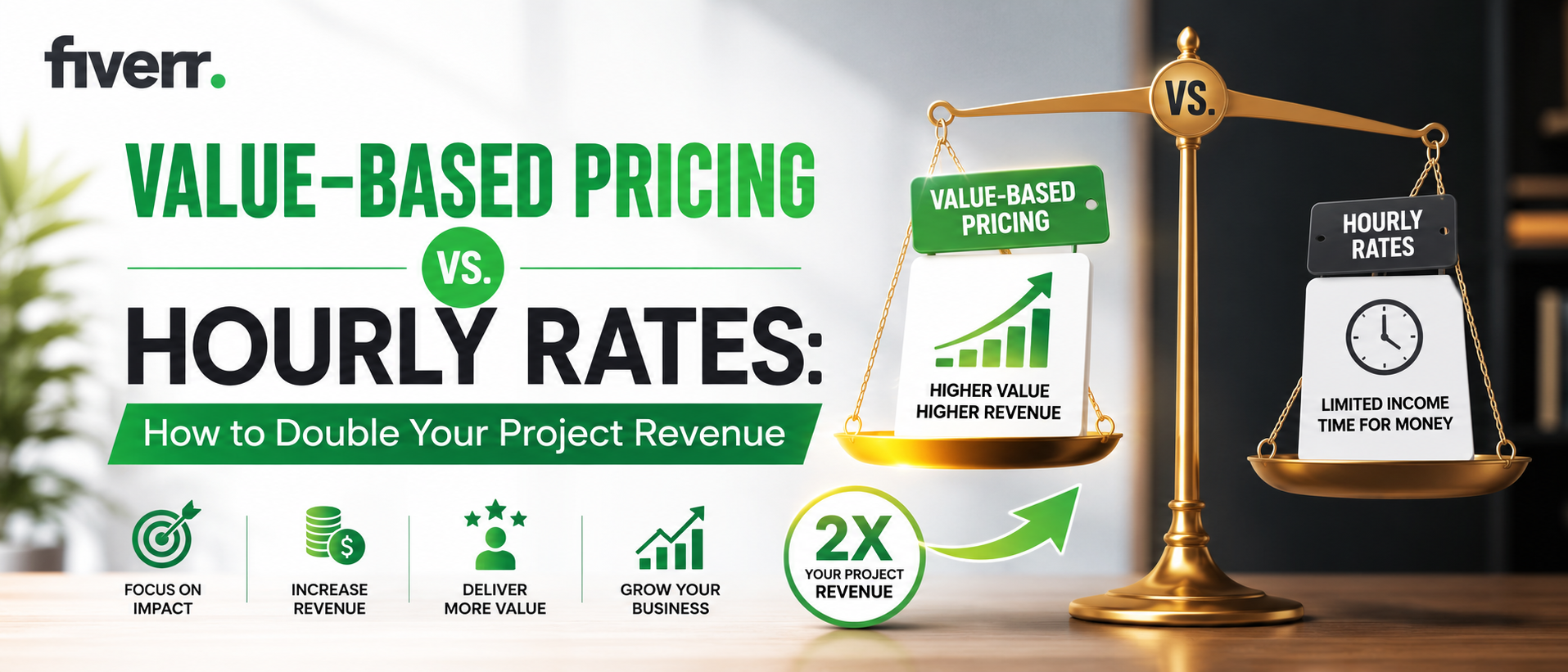
Value-based pricing means setting your fee according to the value a project delivers to the client, not the hours it takes you to complete it. The price is anchored to outcomes: increased revenue, saved costs, reduced risk, faster time to market, or a stronger competitive position.So if a landing page redesign helps a client increase conversions by 2%, and that 2% translates into an extra $80,000 a year in sales, a $9,000 price tag for that redesign isn't expensive — it's a bargain. Compare that to charging $9,000 worth of hours at $75/hour (120 hours), which would be an unusual stretch for a single landing page. The value-based number and the hourly number rarely line up, and that gap is exactly where the opportunity sits.
It's worth being honest about something here: value-based pricing isn't a magic formula you punch numbers into. It's part calculation, part positioning, and part confidence. You're essentially saying, "My expertise is worth this because of what it produces for you," instead of "My time is worth this because that's the market rate." Those are two completely different conversations with a client, and only one of them puts you in control of the negotiation.
Hourly Rates vs. Value-Based Pricing: A Side-by-Side Look
This table tells the story pretty clearly. Hourly billing is transactional. Value-based pricing is strategic. Neither is "wrong" in every situation — sometimes a small fix or maintenance task genuinely is best billed hourly. But for meaningful projects with measurable business impact, value-based pricing almost always wins on revenue potential.
Why Value-Based Pricing Can Realistically Double Your Project Revenue
This isn't a throwaway claim. Here's the mechanism behind it.First, value-based pricing decouples your income from the number of hours in your week. There are only so many billable hours in a month before burnout sets in. Once you're maxed out on hours, hourly billing has nowhere left to grow except raising your rate, which has its own ceiling depending on your market. Value-based pricing has no such ceiling because it's tied to the client's results, not your calendar.
Second, it shifts the buying conversation. When a prospective client asks, "What's your hourly rate?" they're already comparing you to every other freelancer with a similar rate. When instead you ask them, "What would solving this problem be worth to your business?" you reposition yourself as a strategic partner rather than a line item. That single shift in framing tends to unlock budgets that hourly conversations never reach.
Third, value-based pricing rewards speed and skill instead of punishing it. If you can deliver the same outcome in half the time because of experience, tools, or talent, you keep the full fee. That efficiency becomes pure profit margin rather than lost revenue.
Fourth — and this one surprises people — value-based pricing often increases client satisfaction. Clients who pay for outcomes tend to focus on results rather than micromanaging your process or hours logged. The relationship becomes less adversarial and more collaborative, which, ironically, tends to produce better creative and strategic work.
Put those four factors together — no hourly ceiling, stronger positioning, rewarded efficiency, and better client relationships — and doubling project revenue isn't a stretch. For many freelancers and small agencies who've made the switch, it's closer to a baseline expectation than an exaggerated promise.
How to Transition From Hourly to Value-Based Pricing
Switching pricing models isn't an overnight flip. It's a gradual repositioning. Here's a workable path:1. Quantify outcomes before you quote: Ask discovery questions that uncover the financial stakes: What's the cost of not solving this problem? What revenue, savings, or risk reduction is on the table? You can't price a value you haven't identified.
2. Start with project-based pricing as a bridge: If jumping straight to fully value-based fees feels too aggressive, start by quoting flat project fees instead of hourly rates. This gets clients used to paying for deliverables, not your clock.
3. Build pricing tiers around outcomes: Offer packages tied to scope and impact — a "starter" tier solving a narrow problem, and a "growth" or "premium" tier that includes deeper strategic work tied to bigger business outcomes.
4. Anchor your proposals with ROI language: Instead of "20 hours of design work," frame it as "a redesigned checkout flow projected to reduce cart abandonment and recover an estimated $X in lost monthly revenue."
5. Track your own case studies: Every project you complete is evidence. Document measurable results — conversion lifts, time saved, revenue generated — so future proposals can lean on real numbers instead of guesses.
6. Practice the pricing conversation: This is as much a communication skill as a financial one. Roleplay objections. Get comfortable explaining why your fee reflects outcomes, not hours, without sounding defensive.
Common Mistakes to Avoid When Switching
A few pitfalls show up again and again. Pricing too high too fast, before you've built a portfolio of measurable results, can backfire — value-based pricing needs credibility behind it. Another common mistake is failing to define scope clearly; without firm boundaries, "value-based" projects can quietly turn into unpaid scope creep because there's no hourly ceiling acting as a natural brake. Some freelancers also try to apply value-based pricing to every single project, even small, low-stakes tasks where it simply doesn't fit — a hybrid approach (hourly for minor work, value-based for major work) is usually smarter than an all-or-nothing switch. Finally, many people undersell the conversation itself, quoting a number without ever explaining the reasoning behind it, which leaves clients comparing your fee to hourly competitors instead of understanding the value logic at all.Final Thoughts
The shift from hourly billing to value-based pricing isn't just a pricing tactic — it's a mindset change about how you see your own work. Hourly rates tie your income to a finite, exhausting resource: time. Value-based pricing ties your income to something that scales with your skill, your strategic thinking, and the real-world results you create for clients. It takes some recalibration, a bit of courage in early client conversations, and a willingness to track and prove your outcomes.If you're ready to put this strategy into practice, Fiverr gives freelancers and agencies the opportunity to showcase high-value services, attract quality clients, and build a business around results rather than hours. But for freelancers and agencies serious about growing their income without simply working more hours, value-based pricing is one of the few changes that can genuinely double project revenue without doubling your workload.
📈 Earn More
Explore Newsbuck for more exclusive deals and important updates. We are your go-to source for all the news and trending stories across fashion, politics, health, entertainment and much more!
Frequently Asked Questions
1. Is value-based pricing only for high-end consultants and agencies?
No. While it's common in consulting, the same principle applies to freelance designers, writers, developers, and marketers. Any project with a measurable business outcome — more sales, saved time, reduced costs — can be priced based on that outcome rather than hours worked.
2. What if a client refuses to share their revenue numbers or budget?
This happens often, and it doesn't mean value-based pricing is off the table. You can still estimate value using industry benchmarks, comparable case studies, or by asking indirect questions about the cost of the problem rather than direct revenue figures.
3. Can I use value-based pricing and hourly rates at the same time?
Yes, and many successful freelancers do exactly that. Smaller, low-impact tasks can stay hourly, while larger, outcome-driven projects get a value-based quote. This hybrid model lets you transition gradually instead of overhauling your entire pricing structure overnight.