
Introduction
Find Your Perfect TV 📺Picking between OLED vs QLED is one of those decisions that sounds simple until you're standing in a shop with forty screens blasting demo reels at you. Both are premium. Both cost real money. And both claim to give you the best picture. Here's the short overview: OLED lights every pixel on its own, so blacks are truly black. QLED is an LCD TV with a quantum dot layer and a big LED backlight, so it gets brighter and usually costs less. That's the whole fight in two sentences. The rest of this post is about which side wins in your actual room, on your actual wall, with your actual lamp reflecting off it.
If you're ready to compare the latest OLED and QLED models, MediaMarkt is a great place to explore a wide range of TVs and find the right screen for your home.
OLED vs QLED: What's Really Different Under the Glass
Forget the marketing letters for a second.An OLED panel has tiny organic pixels that make their own light. Want black? The pixel just switches off. Completely. Nothing glows behind it, nothing leaks.
A QLED TV works another way. There's a backlight (LEDs, sometimes thousands of them in newer Mini LED sets), then a quantum dot film that boosts the colour, then an LCD layer that acts like shutters. Light has to pass through the whole sandwich. So a black scene is really a very dark grey, no matter how clever the dimming is.
And no, QLED is not "just Samsung's word for OLED." I've heard people say that in real life, more than once. Samsung, TCL, Hisense and others sell QLED. LG and Sony lead in OLED, and Samsung now also makes a quantum dot OLED hybrid called QD-OLED, which confuses everybody. Ugh.
OLED Picture Quality: The Contrast Thing
OLED picture quality comes down to one word: contrast. When a starfield sits next to a black sky, each star glows and the sky stays properly dark. Your eyes read that as depth. It looks almost three-dimensional, kind of like a window instead of a screen.Other strengths worth knowing:
- Viewing angles. Sit at the end of the sofa and the picture holds up. Colours don't wash out.
- Motion handling. Pixels switch almost instantly, so fast scenes look clean.
- Shadow detail. Dark scenes in shows like a moody thriller keep their subtle textures, without a grey haze over everything.
QLED Picture Quality: Brightness and Colour Volume
Now flip it. QLED picture quality shines when the lights are on. Those LED backlights can push very high brightness, which makes HDR highlights (sunlight on water, a car headlight, a spark) really pop. Colours also stay saturated at high brightness, which is what "colour volume" means. Bright and colourful at once.I remember walking past a QLED in a store window at midday and thinking it looked like it was lit from inside. It kind of was. That's the backlight doing its job.
The catch is the backlight itself. Even with local dimming zones, you can sometimes see "blooming," a faint glow around a bright object on a dark background. Think white subtitles on black. Better sets (full array or Mini LED) reduce this a lot. Cheap edge-lit ones? Not so much. And on many QLED models with VA panels, colour and contrast fade when you view from the side. Some use IPS panels, which fix angles but hurt contrast. Trade-offs everywhere.
TV Screen Quality Compared Side by Side
Here's a quick table so you can see the big points without scrolling through paragraphs.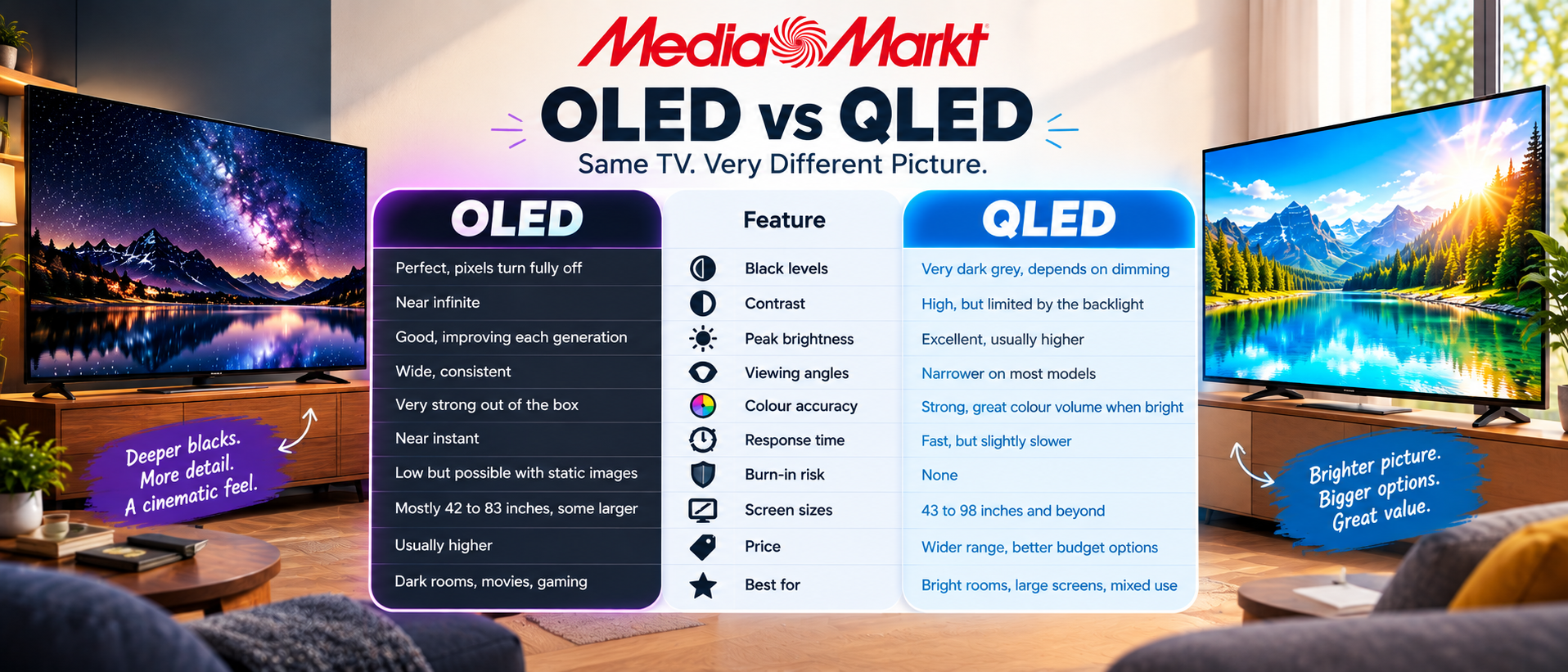
If you only remember one row, remember the first. Everything else comes back to how each panel makes black.
The Best TV for Dark Rooms
So what's the best TV for dark rooms? OLED. Honestly, there's not much of a debate here.Picture a Friday night. Curtains closed, lamp off, some slow sci-fi movie on. On an OLED, space looks like space. On a QLED, even a great one, you might notice a slight glow at the edges of a bright object, or black bars that aren't quite black. Some people never notice. Others can't unsee it once they've seen it.
If your TV lives in a basement, a dedicated media room, or a bedroom where you watch at night, OLED gives you the cinema feeling that QLED can only approximate. Full-array Mini LED QLEDs get impressively close, though, and that matters if your budget can't stretch to OLED. Close isn't identical. But close might be plenty.
So, Is OLED or QLED Better? It Depends on Your Room
People love asking "is OLED or QLED better," and I get why. You want a clean answer. But the honest answer is: better for what, and where?Here's how I'd break it down.
Choose OLED if:
- You watch mostly at night or with curtains drawn
- Movies and streaming series are your main thing
- You care about seeing the picture from wide seating angles
- You want the best contrast money can buy
- Your living room gets a lot of daylight, glare, or big windows
- The TV is on for hours (news, sports, kids' shows)
- You want a very large screen without a huge price
- Burn-in worries you, even a little
Gaming, Sports and Everyday Viewing
For gaming, OLED has a slight edge thanks to that near instant response and great HDR in dark game scenes. Most current sets from both camps offer 120Hz, VRR and low input lag, so console players on PS5 or Xbox Series X will be happy either way.Sports are a bit different. Football or cricket in a bright room? QLED's brightness helps a lot, because the pitch looks vivid even with the lights on. OLED handles sports fine too, but the brighter the room, the more the advantage slides toward QLED.
Everyday TV, like cooking shows, news and YouTube in the background, is where QLED's lack of burn-in worry is a comfort. Which brings up the thing everyone asks about.
Burn-in, Lifespan and Price
Burn-in on OLED is real, but it's often overblown. It happens when a static image (a news ticker, a game HUD, a channel logo) sits on screen for a very long time at high brightness. Modern OLEDs use pixel shifting, logo dimming and refresh cycles to fight it. If you vary your content, you'll probably never see it. If you leave a 24 hour news channel on all day, every day... maybe think twice.QLED can't burn in, so no stress there. Lifespan on both is typically many years of normal use, though backlights and panels age differently.
Price is where QLED usually wins. You can find decent QLEDs at prices where OLED options are very thin, and at bigger sizes like 75 or 85 inches the gap grows. OLED prices have been falling, though, and sales can narrow the gap fast. It's worth checking current prices before deciding, because they move a lot around festive seasons.
QLED TV Buying Guide: What to Check Before You Pay
If QLED is where you're leaning, this QLED TV buying guide section is for you. A few things matter more than the model name.1. Look for local dimming: Full array local dimming or Mini LED is a big deal. Edge-lit budget QLEDs have weaker contrast and more blooming. The more dimming zones, generally the better the black levels.
2. Check peak brightness: For real HDR, look for numbers well above 1,000 nits. Some spec sheets are vague, so read independent reviews (RTINGS is a good example) instead of trusting the box.
3. Know your panel type: VA panels give better contrast but narrower angles. IPS gives wide angles but weaker blacks. If you sit right in front, VA is usually the better pick. If the family piles onto a sofa, think about IPS.
4. Don't ignore the processor: Upscaling matters, because lots of your content (older shows, cable, YouTube) isn't 4K. A good processor makes it look cleaner.
5. Anti-glare coating: Some QLEDs have excellent matte or low reflection screens. In a bright room, this can matter as much as brightness itself.
6. Ports and gaming features: HDMI 2.1, 120Hz, VRR, and ALLM if you game. Simple, but people forget it until they're home with the box open.
7. Smart platform: Tizen, Google TV, Fire TV, whatever. Try it in the shop if you can. A laggy menu will annoy you every single day.
And, one more thing. Ignore the "demo mode." Stores crank brightness and saturation to the max, and no living room looks like that. Ask them to switch to a standard or cinema preset, then judge.
A Quick Reality Check on TV Screen Quality
Here's something reviewers don't say loudly enough. Most of us can't tell tiny differences in TV screen quality once the set is at home, playing regular content, with a family member talking over the dialogue. Both OLED and QLED are, frankly, way better than what we had ten years ago.What you will notice: glare in a bright room, or grey blacks in a dark one. So match the TV to the room, and you've solved 90 percent of the problem. The last 10 percent is brand taste, budget, and whether the remote feels nice in your hand (it matters, weirdly).
Final Thoughts
So, OLED vs QLED. If your evenings are dark and cinematic, OLED gives you a deeper, more dramatic picture, and it's the best TV for dark rooms without much argument. If your room is sunny, your screen is huge, or your budget is tight, a good QLED delivers brightness and value that OLED can't easily match. Neither is a mistake. The wrong choice is really just buying a room you don't have. Think about where the TV sits, when you watch, and how much light hits the screen. Then decide. And if it's still a coin flip, go stand in front of both, in the standard picture mode, and trust your own eyes.When you're ready to upgrade, check out MediaMarkt for a wide range of TVs and home entertainment options to find a screen that fits your room and viewing needs.
Explore Newsbuck for more exclusive deals and important updates. We are your go-to source for all the news and trending stories across fashion, politics, health, entertainment and much more!
Find Your Perfect TV 📺
Read Our More Blogs:
What Is A Chatbot And Does Your Business Actually Need One?
Refurbished, Explained: What You're Really Buying When You Skip 'Brand New'
Cashmere And Premium Wool: The Best Luxury Knitwear Offers Today
1. Is OLED or QLED better for watching movies?
OLED usually is. Its perfect blacks and near infinite contrast make dark movie scenes look richer and more natural, especially in a dim room. A high end Mini LED QLED can look great too, but OLED still leads for a true cinema feel.
2. Does QLED have a burn-in like OLED?
No. QLED TVs use an LED backlight with an LCD panel, so they don't suffer from permanent image retention. OLED can burn in if static images stay on screen for very long periods, though modern protective features make it rare for typical viewing.
3. Which is better value, OLED or QLED?
QLED generally offers better value, particularly at larger screen sizes and lower price points. OLED costs more but gives superior contrast and viewing angles. If you watch in a dark room and can afford it, OLED is worth the extra. Otherwise, a well chosen QLED is a smart buy.