
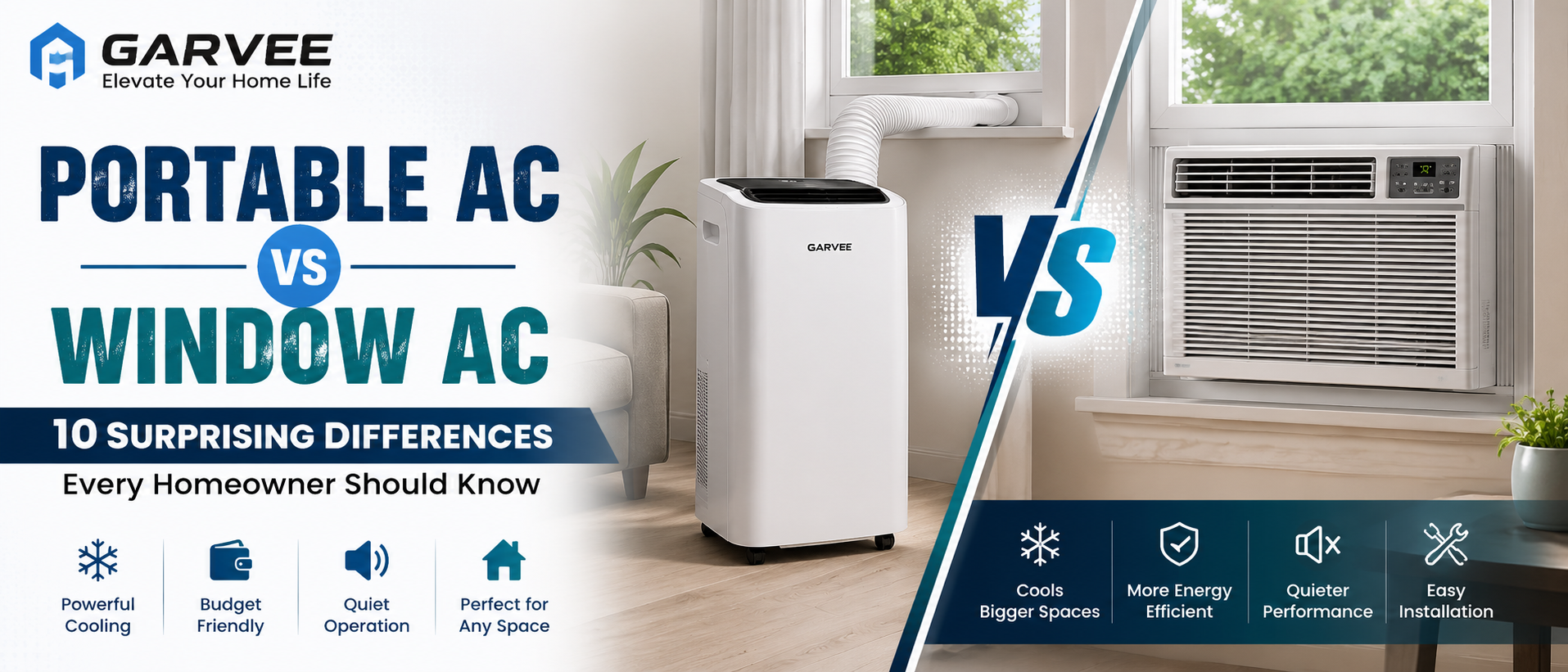
Overview
❄️ Beat the HeatBefore we get into the details, it helps to understand what you are actually comparing against. A window AC is a self-sufficient, sealed unit that installs in a window frame or a wall opening. It pulls in warm air, cools it and pushes the heat out the back of the unit. A portable AC is a freestanding box on wheels that you can roll from room to room, with a flexible exhaust hose that vents hot air out through a window kit. GARVEE offers a wide range of reliable portable and window air conditioners, making it easy to find the right cooling solution for your home and budget.
They sound alike on paper. In reality, the portable ac vs window ac debate covers everything from your electricity bills to the amount of noise you hear when trying to sleep. Let's take this point by point.
Portable Air Conditioner vs Window AC: Key Differences
When homeowners search for portable ac vs window ac they are usually trying to solve one of three problems: saving money, saving space, or having a simple installation. A quick snapshot of each of the categories before we dive deeper.Cooling method: The room is cooled directly by the wall or window opening with a window AC. A portable AC pulls heat from the air inside, and forces the heat out a hose.
- Mobility: Window AC remains stationary. You can move portable AC from room to room.
- Efficiency: Typically, window AC units are more energy efficient per BTU of cooling.
- Installation: Window AC requires the right kind of window and some physical labor. Portable AC requires little installation; just set up the vent hose.
- Price range: Portable ACs are often more expensive for the same cooling power.
Energy Efficiency and Running Costs
This is where the biggest difference will be noticed by most homeowners, especially when the electricity bills arrive at the end of a hot month.Sealed in one box, window air conditioners are. All the components, including the compressor, condenser and evaporator are located together, reducing cool air loss. Most window units also have a higher energy-efficiency ratio (EER) than comparable-capacity portables.
Because portable AC units are so portable, they aren’t as efficient. The exhaust hose has to push hot air out, but it also pulls in some warmer air from outside the room through gaps around the window kit. Sometimes this is called “negative pressure” and makes the unit work harder to keep the set temperature. This means that a portable AC will often need a higher BTU rating to cool the same size room as a window AC, and higher BTU usually means higher electricity bills over time.
If the priority is to lower your monthly electricity bills, a window AC usually comes out on top. But if you only need cooling in short bursts, the flexibility of a portable AC might make up for the slightly higher running costs.
Installation and Portability
Here is where portable AC units genuinely shine.Window AC installation usually involves lifting a heavy unit, securing it in the window frame, and sometimes calling in a second pair of hands (or a professional) to avoid damaging the window or dropping the unit. Landlords in rental apartments may also restrict window AC installation because it can affect the building's exterior appearance or safety.
Portable AC units, by comparison, need almost no installation. You place the unit on the floor, extend the exhaust hose out through a window using the included kit, and plug it in. There is no drilling, no permanent fixture, and no risk of the unit falling out of a window. This makes portable AC a strong choice for renters, people who move frequently, or anyone who wants to shift cooling from the bedroom during the day to the living room in the evening.
So if portability and easy setup matter more to you than squeezing out every bit of efficiency, portable AC has a clear edge here.
Cooling Performance and Capacity
Cooling power is measured in BTUs (British Thermal Units), and this is another area where the portable ac vs window ac comparison gets interesting.Window AC units tend to cool more effectively per BTU because there is less energy loss in the cooling process. A 10,000 BTU window AC can often cool a room just as well as a 12,000 BTU portable AC of similar build quality. This matters when you are choosing the best air conditioner for home use in a specific room size, since buying the wrong capacity leads to either wasted energy or a room that never quite feels cool enough.
Portable units also tend to struggle more in larger rooms or spaces with high ceilings, simply because of that negative pressure effect mentioned earlier. If you have a large living room or an open floor plan, a window AC (or even a split AC) may give you more consistent comfort.
Noise Levels
If you are a light sleeper, this section deserves your full attention.Window AC units place the compressor, which is the noisiest part of any air conditioner, outside the room (technically outside the window, but the bulk of the noise-generating parts sit further from your living space). This design generally results in a quieter experience indoors.
Portable AC units keep the entire system, including the compressor, inside the room with you. Even with insulation and design improvements, portable units are often noticeably louder than window units of similar capacity. Some models run between 50 to 60 decibels, which is roughly the sound of a normal conversation, and that can be distracting during sleep or work calls.
If noise is a dealbreaker, lean toward window AC, especially for bedrooms.
Maintenance and Upkeep
Both types of air conditioners need regular filter cleaning, but the process looks a little different.Window AC filters are usually easy to slide out and rinse, and the unit itself rarely needs to be moved once installed. Portable AC units require a bit more attention because they generate condensation that either needs to be drained manually or evaporates automatically depending on the model. Some portable units have a bucket that needs emptying every few days during humid weather, which is an extra chore many homeowners don't anticipate when they first buy one.
Aesthetic and Space Considerations
A window AC permanently occupies part of your window, which can block natural light and change how a room looks from both inside and outside. Some homeowners find this visually unappealing, especially in living rooms or spaces with a nice view.A portable AC takes up floor space instead, which some people find more manageable since it does not alter the window's appearance. However, it does mean losing a chunk of floor area in the room, plus the exhaust hose running to the window can look a bit messy if not managed well.
Upfront Cost vs Long-Term Value
The portable AC units tend to be more expensive than a window AC with similar cooling capacity. That’s partly because of the extra engineering for the hose system, wheels and mobility features.Window AC units are often more efficient and cheaper to run month-to-month. The picture can change though over a few years of operation, depending on your electricity bills. A window AC can be more cost-effective in the long run if you plan to stay in one home for several years. If you anticipate being on the move a lot or want cooling in different rooms at different times, you can justify the higher price of a portable AC for its flexibility.
Best For / Not Best For
Window AC is best for:- Homeowners who want lower electricity bills over time
- Bedrooms and spaces where quiet operation matters
- Homes with compatible window sizes and no rental restrictions
- Larger rooms that need consistent, powerful cooling
- Renters who cannot alter windows
- Rooms without a standard window opening
- People who want to move cooling between rooms easily
- Renters and people who move frequently
- Rooms without a standard window (using a wall vent kit)
- Homeowners who want to shift cooling between rooms as needed
- Quick, temporary cooling solutions for home offices or guest rooms
- Homeowners focused on minimizing electricity bills
- Bedrooms where noise is a concern
- Larger rooms or open floor plans
Final Thoughts
Ultimately, the choice of portable ac vs window ac is a matter of preference based on what is most important to you in your specific living situation. If you own your home, have a suitable window and want the best air conditioner for home comfort at the lowest possible running cost, a window AC is generally the smarter long-term investment. “It’s usually quieter, more energy efficient and easier on your electricity bills month after month.”If you're comparing reliable cooling solutions, GARVEE offers a range of portable air conditioners and home comfort products designed to deliver dependable performance, convenience, and value for modern households.
But if you rent, move around a lot, or need a flexible cooling option for home spaces that change throughout the seasons, a portable AC offers a convenience that a fixed window unit just can't compete with. Neither is 'better' in any universal sense - they just serve different needs. Consider the size of your room, your budget, your noise tolerance and how long you expect to be in your current home before making the final decision.
Whichever you choose, portable AC and window AC units have improved dramatically in their design and efficiency, and either will keep your house comfortable in the hottest months of the year.
❄️ Beat the Heat
Explore Newsbuck for more exclusive deals and important updates. We are your go-to source for all the news and trending stories across fashion, politics, health, entertainment and much more!
FAQs
1. Which is cheaper to run, a portable AC or a window AC?
Window AC units are generally cheaper to run because they lose less cool air and require lower BTU capacity for the same room size, which usually translates into lower electricity bills over time.
2. Can a portable AC cool a room as well as a window AC?
Yes, but it usually needs a higher BTU rating to match a window AC's cooling performance, since portable units lose some efficiency due to negative pressure and hose length.
3. Is a window AC or portable AC better for renters?
Portable AC is typically better for renters since it requires no permanent installation and does not alter the window or building exterior, making it easier to move out or relocate without any restoration work.