
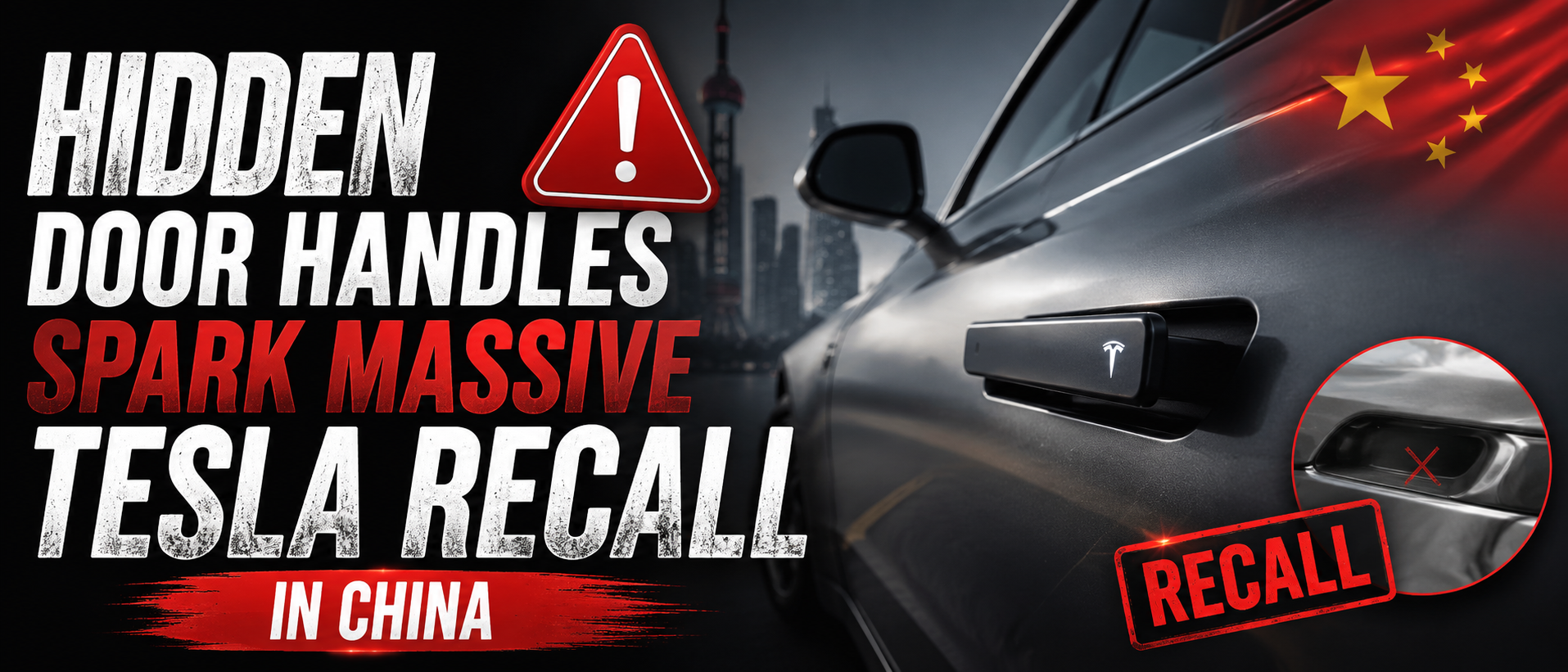
Popularized largely by Elon Musk's Tesla, this minimalist handle style has since spread across the auto industry worldwide. However, a string of incidents has raised alarm that the design could make it dangerously difficult to open doors during emergencies.
Safety Concerns Behind the Sleek Design
Hidden door handles have become the norm in China's EV market, with roughly 60% of the country's top 100 best-selling new energy vehicles, including both electric and hybrid models, featuring them. According to Stephen Dyer, a car industry analyst at consultancy AlixPartners based in Shanghai, the design gives vehicles a cleaner look and helps reduce wind resistance, but can be genuinely confusing to operate. Dyer admitted that even he sometimes struggles to find the interior release switch in an unfamiliar car.
Beyond simple inconvenience, these handles have been linked to serious safety risks. Lyu Chen, an associate professor at Nanyang Technological University, explained that electronically powered handles became a popular industry trend but have raised real safety concerns whenever doors fail to open quickly, delaying rescue efforts after crashes. Chen noted that a door handle might seem like a minor detail, but it becomes critical in the moments immediately following a collision.
Chinese automaker Xiaomi faced heavy scrutiny after two fatal crashes involving its SU7 model in 2025, both reportedly linked to electrical failures that trapped occupants inside. One crash, which occurred on a highway in Tongling city in eastern China, killed three people. Relatives of the victims said passengers were unable to escape because the doors couldn't be unlocked following the collision. Xiaomi stated at the time that the SU7 included mechanical emergency releases at the base of each door that would work even without power, and said it was cooperating with police during its investigation. The company's newer SU7 models now include redesigned handles that can open without electrical power.
Tesla has faced similar legal challenges in the United States. The company was sued by the sole survivor of a 2024 crash involving its Cybertruck electric pickup, which killed three college students in California. According to the survivor's legal team, the vehicle's lack of traditional handles and its reliance on electronic buttons meant passengers couldn't escape the burning car. One attorney representing the survivor argued that designing a vehicle without a mechanical way to open doors from the outside essentially bets everything on the electronics working under any circumstance, including a severe crash followed by fire. Tesla has denied wrongdoing in court, maintaining that the Cybertruck meets US federal safety standards. Additional cases in the US have also alleged that passengers, including children, became trapped in Tesla vehicles after their doors stopped functioning.
China Moves to Ban the Design
In February, China became the first country to announce a ban on hidden door handles. Under the new rules, which take effect January 1, 2027, new vehicles sold in the country must include physical release mechanisms on both the interior and exterior of doors, along with clear signage inside the car explaining how to open them.
China's move puts it ahead of the US and European Union, regions that typically set the pace for road safety and emissions standards, according to Dyer, who suggested the sheer scale of China's EV market likely played a role in prompting quicker action.
On August 21, China's State Administration for Market Regulation announced that Tesla, along with major domestic automakers including Xiaomi, XPeng, and Geely, would recall a combined total of more than four million vehicles. As part of the recall, manufacturers must add warning labels inside vehicle doors explaining how to open them, and some vehicles will receive a software update designed to automatically lower windows in the event of a crash.
Tesla, which began selling the Model S with hidden door handles in China back in 2014, is recalling nearly three million vehicles as part of the action. Regulators said the affected handles are difficult to identify because they closely match the color of the surrounding interior trim. The agency also warned that during an electrical failure, the handle design could prevent passengers from escaping quickly or make it harder for bystanders to assist in a rescue. Xiaomi, XPeng, and Geely combined will recall more than 750,000 additional vehicles.
Some engineers argue the new measures don't go far enough. Lim Hong Wee, an engineering instructor at the National University of Singapore, said the rules fail to guarantee a reliable mechanical way to open doors, arguing that emergency access to a vehicle shouldn't depend on software functioning correctly. Gokul Krithivasan of risk management firm SecureSafe added that the measures focus mainly on helping occupants get out, but don't ensure rescuers can get in during an emergency. He also called warning labels a weak solution, noting that panicked individuals tend to rely on instinct rather than reading fine print, especially inside a dark or smoke-filled cabin.
It remains unclear whether similar recalls will be issued outside China, and there are currently no indications that automakers have notified US regulators of plans for a comparable recall.