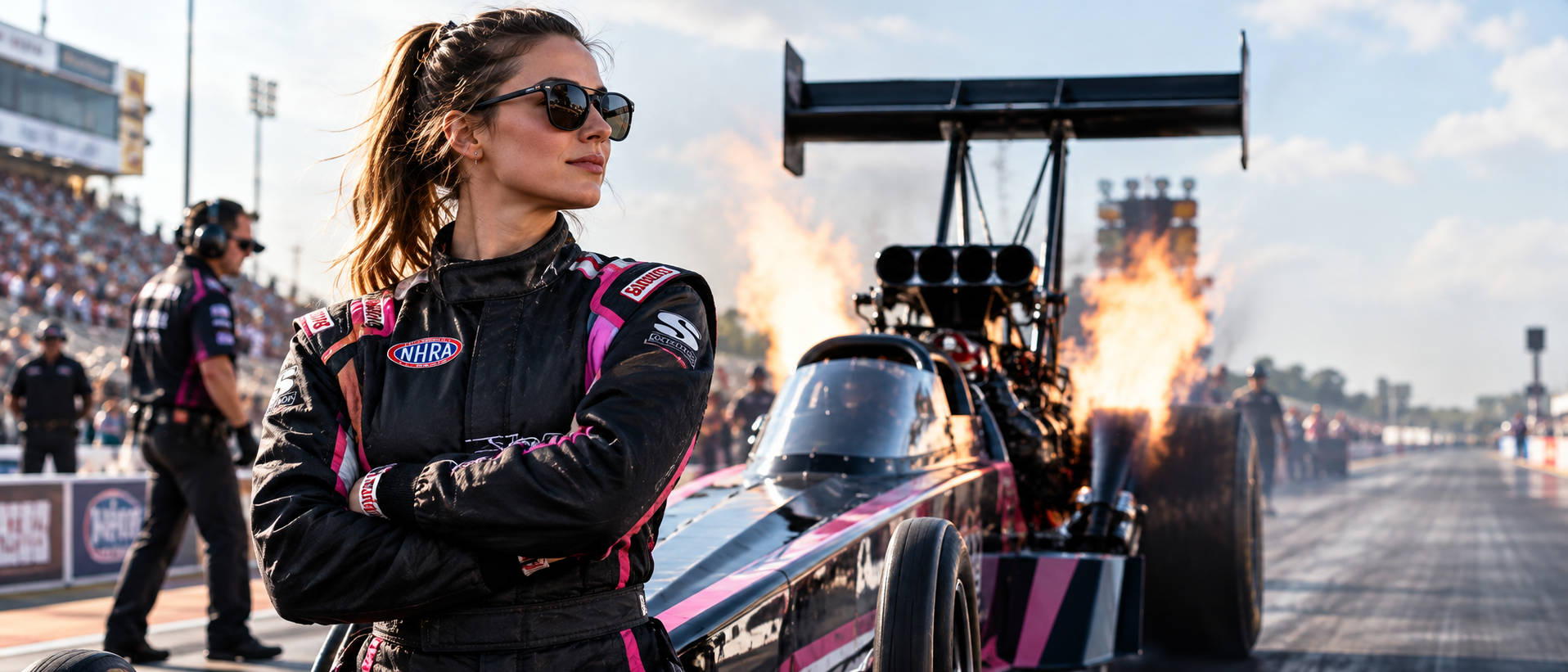
It is also the only elite class of motorsport where women regularly beat men to major titles. Women have won seven of the past nine European Championships, and US driver Brittany Force held the world speed record until recently. By comparison, it has been 50 years since a woman even competed in a Formula 1 Grand Prix. So why is this sport bucking the trend?
Life at 300mph
Women make up about 10% of participants across motorsport and just 4% of elite drivers, according to campaign group More Than Equal. In this year's US and European Top Fuel seasons, though, they were 20% of the field. The group calls drag racing "the most gender-equal motorsport in the world." Top Fuel is its most extreme form, named after the nitromethane fuel the cars burn.
Races run on a straight 1,000-foot (305-metre) track, usually with two cars side by side. The first hit comes in the opening second, as the cars go from standing still to 100mph. A second one arrives around halfway, when the clutch fully engages. Callin, 43, calls the adrenalin rush "extremely addictive." Worry about the risks "is always there," she says, but "the safety really does work." Protection has improved further since fatal crashes in nitromethane cars in 2004 and 2008, and races were shortened.
Even spectators feel it, with vibrations shaking the ground and their bodies. Ear defenders are advised, as the noise is comparable to standing beside a jet taking off. The top official Top Fuel speed is over 346mph, against 231mph in a Formula 1 Grand Prix. Brakes can't stop the cars alone, so parachutes open at the finish. That sudden stop feels "like someone kicking you in the chest," Callin says. Drivers need lightning reactions, endurance and precise control. "By the time you've thought about it, it's too late," she says. Her friend and rival, 32-year-old Swiss driver Jndia Erbacher, jokes that it also takes "balls."
Role Models and a Welcoming Culture
Callin won her second straight European title in September at Santa Pod, near Northampton. It is the fourth year in a row a woman has taken the crown. In the US, Brittany Force won the National Hot Rod Association (NHRA) championship in 2017 and 2022.
Fran Longstaff, chief innovation officer at More Than Equal, calls drag racing "highly unusual." Women winning has become "normalised rather than treated as exceptional," she says. Research she co-led found no physical or biological explanation. Instead she points to a steady stream of visible female role models and an accessible grassroots structure, with junior programmes, open pits and a family-oriented, collaborative culture.
Women began winning big races "decades and decades ago," Callin notes. The best known is Shirley Muldowney, the "first lady" of drag racing. She was the first woman with a Top Fuel licence and won the NHRA championship in 1977, 1980 and 1982, becoming the first driver with three titles. She fought for her place and sometimes faced hostility, but is now praised for her perseverance. Callin says she has never felt underestimated or badly treated for being a woman. That contrasts sharply with Formula 1 hopefuls, some of whom say they were deliberately pushed off karting tracks and faced sexist comments.
Family, Safety and Cost
Racing runs in families here. Callin followed her father and uncle into the sport. Erbacher's father Urs was a three-time European Top Fuel champion, and Brittany Force's father John holds 16 NHRA titles. Mothers succeed too. Callin stepped away for more than a decade to raise her daughter and stepdaughters, then returned at 35 and her career took off. Finnish driver Anita Mäkelä has won the European title four times, three after a six-year break for her children and her family's chicken farm.
Callin's dad is still on her team, and her husband Keith Bartlett, sometimes called the "godfather" of UK drag racing, runs Santa Pod Raceway. Two of their daughters drove junior dragsters at 80mph before they could take a standard driving test, and the youngest, Jacqueline, 19, now races in adult classes. Rivalry stays friendly. When Callin's car was damaged at last year's championship, Erbacher offered her spare parts. "We hate each other at the starting line, but we love each other at the finish line," she says.
Both drivers talk about having "respect" for the car and the risks. Fire-resistant suits and protected cockpits help, and drivers often escape crashes with little harm. Callin has had two major crashes, with a concussion and a bruised collar bone but no lasting injuries. Even so, she isn't sure she'd be comfortable with her daughter racing Top Fuel. Erbacher's father first refused to let her race, then relented when she said she'd do it anyway, and he now manages her team.
Cost is another factor. Reaching Formula 1 takes millions of pounds and heavy sponsorship. Elite drag racing is pricey too, but on a smaller scale, and at the lowest level, "track days" let people turn up in ordinary cars. The European championship has four events, two in the UK and one each in Germany and Sweden, with six races per driver at each. Prize money mostly helps cover costs. The US championship has 20 events, and one drag racing website reports $500,000 (£378,000) for the 2026 winner.
Breaking Barriers Worldwide
The US, Europe and Australia have all had female champions, though elsewhere Top Fuel is rare. Women are making their mark in Brazil, including Fabiola Dal Bo, who has held a category record. A South African team hosts all-female races, and the TV show The Fastest in Arabic has raised the profile of women racers in the Middle East. In India, 35-year-old Uvashri Kannadasan Balajeyanthi, known as Octy Girl after her modified Skoda Octavia, beat male rivals in the Valley Run series across three categories from 2022 to 2024. She has "mixed feelings" when people act surprised. "Anyone can drive, right?" she asks, though she sometimes feels proud of breaking barriers.
In Europe, Callin calls being a woman on the strip "super-normal." She calls back-to-back titles a "massive achievement," and her next goal is to be the first person, man or woman, to win three in a row.