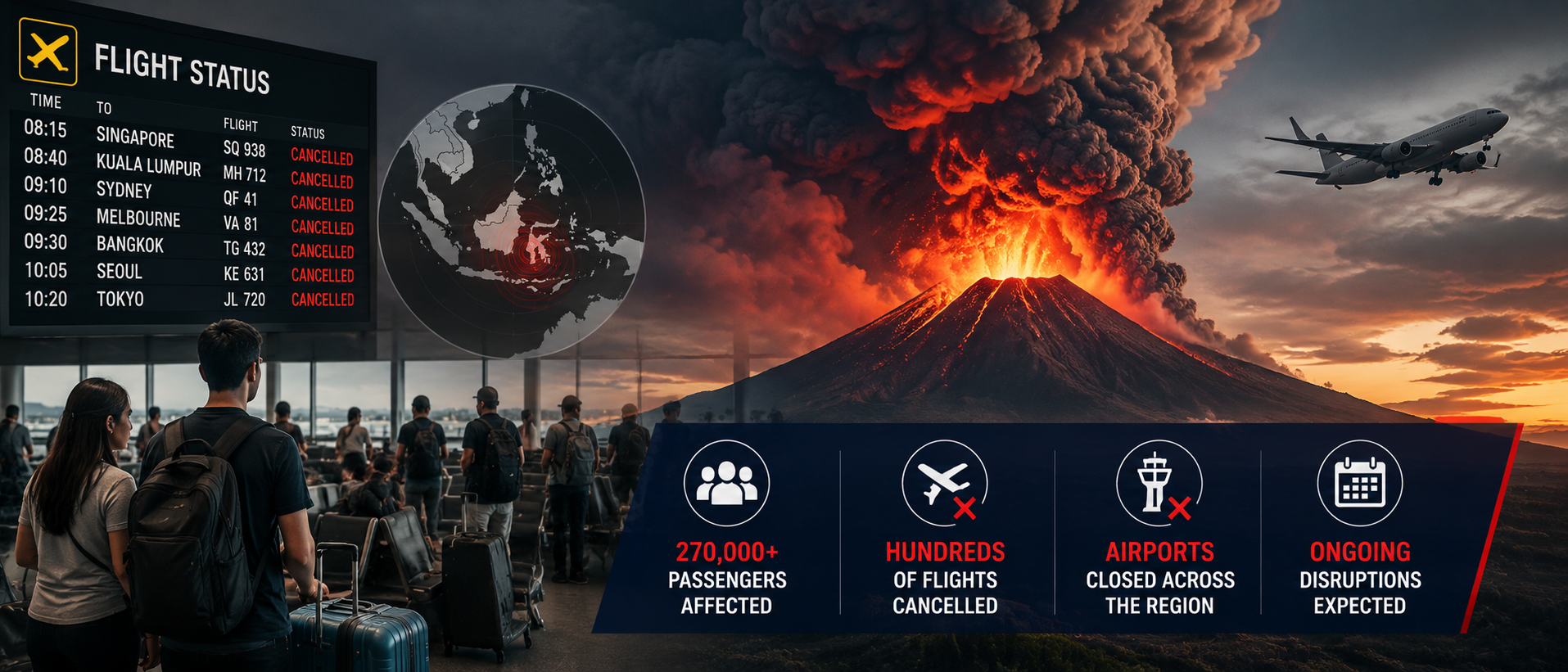
Jakarta's Soekarno-Hatta International Airport, along with three other airports, extended their closures until 18:00 local time on Monday after ash was detected drifting into nearby airspace. In response, schools in affected areas shifted to online learning, and several shipping operations faced disruptions as well.
Passengers Face Long Waits and Uncertainty
Long lines formed at departure halls inside Jakarta's Soekarno-Hatta International Airport on Monday, as stranded travelers sought refunds and tried to get updates on when flights might resume. Finna, a 46-year-old traveler originally scheduled to fly home to Jakarta from Malang in East Java on Sunday morning, described the chaotic scene as flights were repeatedly rescheduled. She said the airport grew increasingly crowded as passengers from earlier flights piled up alongside those unsure whether their later departures would even happen, with everyone glued to the flight information boards for updates. Rather than wait indefinitely, Finna ultimately took two separate intercity trains overnight, arriving in Jakarta at 3:00 a.m. Monday.
Jo Shaw, visiting Indonesia with her conservation charity Save the Rhino International, said everyone around her seemed to be scrambling to figure out alternative travel arrangements. Her team had already canceled plans to camp at Java's Ujung Kulon National Park after authorities raised the alert level for Anak Krakatau. Shaw said being stuck in an airport hotel was a relatively minor inconvenience that would likely resolve within a few days, though she expressed greater concern for conservation teams working directly with rhinos under such volatile environmental conditions.
A newlywed couple from Malaysia, who had just wrapped up a week-long trip to Bali, said they were informed their next available flight back to Kuala Lumpur wouldn't depart until September 11. Amir Hamzah, 29, said he and his wife hadn't budgeted for an extended stay and had only planned for enough money to cover their honeymoon, expecting to fly home the day before. He explained that they initially thought they'd simply wait a few hours at the airport and catch a morning flight on Monday, never imagining they'd end up stranded for days.
Volcanic Activity Remains Unpredictable
On Monday, Indonesia's Geological Agency warned that the likelihood of further eruptions in the near future remains high. According to the country's meteorological agency, volcanic ash has risen as high as 6,000 meters on the Java side of the volcano and up to 15,000 meters on the Sumatra side, with ash also reaching parts of Banten, Java's westernmost province. Anak Krakatau sits within the Sunda Strait, positioned roughly between the islands of Java and Sumatra, with its most recent eruption recorded at 20:23 on Sunday.
Transport Minister Dudy Purwagandhi said it remains impossible to predict exactly when the disruptions will end due to constantly shifting weather conditions. He noted that authorities have been conducting tests every 30 minutes across affected airports to monitor whether the ash cloud is expanding or beginning to dissipate. Officials have also warned the public to stay at least 3 kilometers away from the active crater, while ships traveling through the Sunda Strait have been barred from entering the same 3-kilometer exclusion zone. Authorities confirmed there is currently no tsunami warning tied to the volcano's recent activity.
Anak Krakatau, whose name translates to Child of Krakatoa, has experienced intermittent activity since first emerging from the sea in the early 1900s, forming within the caldera left behind by the catastrophic 1883 eruption of Mount Krakatoa. In December 2018, a partial collapse of the volcano triggered a massive tsunami that killed more than 400 people and displaced or injured thousands more along the coastlines of Sumatra and Java. Researchers later found that some of the rock fragments that broke off during that collapse measured between 70 and 90 meters tall.
The volcano sits along the Pacific Ring of Fire, a vast chain of volcanoes, earthquake zones, and tectonic plate boundaries stretching roughly 40,000 kilometers from the southern tip of South America all the way to New Zealand. This region accounts for nearly 90% of the world's earthquakes and is home to about 75% of all active volcanoes on Earth, totaling 452 individually active volcanoes.