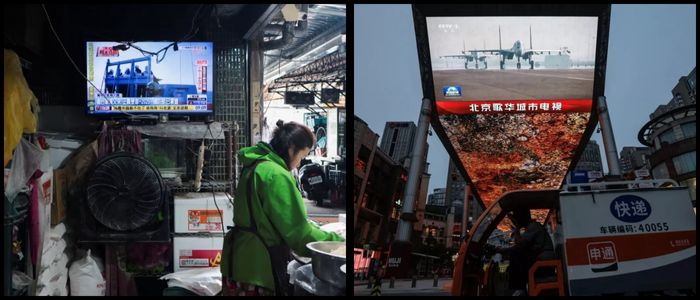
Beijing made this announcement broadly during a time of increased tension across the region, as the United States has just completed major arms sales to Taiwan and continues to see a significant rise in diplomatic tensions throughout the region. Continued and longstanding disputes regarding areas of Security and Sovereignty have also helped fuel rising tensions in the region.
Related War Drill Activities Encircling The Island
The Official Military Public Announcement advised that the “Justice Mission 2025” Military Drill Activities will include: testing combat readiness, “thermally blocking / controlling key Ports and other areas”. Live-fire training drills will occur across five (5) Maritime Zones and various Air Spaces adjacent to Taiwan; this Training will focus on Live-Fire Training Drills only.
Taiwan has condemned the announcement of the Drill and called the actions of China “military intimidation. The Taiwan Defense Ministry stated that “Taiwan is at a State of High Readiness, meaning that all Taiwan military forces are able to mobilize and conduct 'rapid response training' quickly if needed to do so.
Currently, Taiwan places pressure on Mainland China not engage in these drill activities due to the “high level of risk that could lead to major miscalculations of the situation in the Taiwan Strait”. Beijing announced its military activation plans for Taiwan while focusing on the Taiwan Strait and is using ongoing tensions between China and Japan and the dramatic increase in US Weapons Sales to Taiwan as a justification for the increase in military buildup by China to counter-offensive build-up by Taiwan and the USA.
Taiwan's President Tsai Ing-wen has proposed a Special Global Defense Budget, an action that Beijing views as being provocative. Taiwan is claimed by the People's Republic of China as a territory, despite the Chinese Communist Party never having controlled Taiwan. The Chinese Communist Party is prepared to seize control (if necessary, by whichever means appropriate).
In recent years, the Chinese Communist Party has conducted substantial military drill movements around Taiwan, particularly during Sensitive Political Moments, to voice displeasure through military intimidation.
Shi Yi, spokesman for the Eastern Theatre Command, states that these military drills include “training in element combat operations; preparing to establish comprehensive control of the Taiwan Strait” and “exercising a blockade and control over critical areas”.
In the official Chinese commentaries, military analyst Fu Nan has remarked that the military exercises are directly related to the recent Canadian Arms Sales (on two occasions) and have escalated the so-called “colossal action” of the US and Taiwan.
Taiwan’s Presidential spokesperson, Karen Kuo, stated that the Chinese military drills “are an obvious challenge to the current Security and Stability of the Taiwan Strait and the Regional Indo-Pacific Status Quo” and a challenge to the established International Rules and Laws.
U.S.-Taiwan Arms Deal and Increase in Defense Support:
The recent $11.1 billion Defense Package provided by the U.S. to Taiwan includes howitzer-type munitions, which have represented a growing concern that the U.S. Congress recognizes (and supports the development of) Taiwan’s use of U.S. weapon systems.
While the U.S. recognizes and accepts that “PRC” is the Sb to China and recognizes that China has jurisdiction over Taiwan, the U.S. has never accepted China’s sovereignty claim over Taiwan. Under US law, the United States is required to provide assistance to Taiwan to protect itself and maintain close, but unofficial, relations with Taipei.
As a result of this relationship, the two nations have increased their security cooperation in recent years. China has condemned the most recent deal as violating China's sovereignty, security, and territorial integrity and threatening peace in the Taiwan Strait.
Chinese military exercises have coincided with the recent surge of nationalistic rhetoric, including propaganda imagery depicting incendiary arrows striking Taiwan, along with the phrase “Arrow of Justice, Control & Denial.”
As of two days prior to this announcement, naval and air forces of China had begun conducting patrols for combat readiness on December 29; additionally, notices regarding closures due to live firing throughout designated maritime and airspace areas of Taiwan were distributed on December 30 between the hours of 6:00 AM to 3:00 PM, although it was unclear the length of time these exercises will run.
While conducting naval and air drills, the Chinese Coast Guard also announced it would conduct “law enforcement” patrols near Taiwan and a few nearby “outlying” islands, thereby increasing China’s pressure via its surrounding waters.
In light of the increased frequency and intensity of China's military drills being conducted around Taiwan, many of Taiwan’s military forces have been placed on continuous heightened alert due to an increased frequency of Chinese military aircraft and naval ships operating nearby. A proposal for a $40 billion special defense budget presented by President Lai Ching-te in late November aimed to provide additional funding, but there has been a delay in moving forward due to the opposition-controlled legislature. This will impact several components of the U.S. Army's most recent weapons package.
Increased tension within the region and potential future conflict
The ongoing conflict between Beijing and Taiwan is developing concurrently with a renewed emphasis by Beijing to focus on Taiwan in diplomatic communications. The conflict with Japan has increased based on comments made by Sanae Takaichi regarding Japan's military response to an attempted takeover of Taiwan by China. Beijing denounced that statement as a threat to its sovereignty.
Taiwan continues to be the focal point of both China's and the U.S.'s relationships. The Chinese government continues to criticize increasing cooperation between Washington and Taipei as it relates to growing independence sentiment in Taiwan. Beijing has warned repeatedly warned that continued arms sales and political interactions can bring both nations to the brink of war.
Yet, Taiwan continues to believe it is necessary to build up its defenses as a deterrent against coercive actions taken by China. Karen Kuo reiterated that both preparedness and dialogue will help maintain peace between Taiwan and China. While Taiwan seeks to create a stable relationship with China, it remains unyielding to intimidating measures taken by Beijing.
Shi Yi reiterated that the goal of "Justice Mission 2025" is to demonstrate to the international community that China is prepared to defend its national sovereignty and unity with its military. The way in which the Chinese military is framing the operations that are conducted during "Justice Mission 2025" is as one of both defense and necessity. However, the sheer number of drills being conducted by China, combined with the number of live-fire zones that exist surrounding Taiwan illustrate the potential for a routine training operation to escalate to the level of a confrontation.
Multiple observers have noted that China frequently synchronizes public displays of military force with significant political events. In this case, the landmark arms sale, the announcement of Taiwan's new defense-related budget, and a growing political dispute with Japan created circumstances that Beijing views as unacceptable.
Taiwan's government faces the mounting challenge of balancing deterrent capabilities with diplomacy. The government of Taiwan will continue to closely monitor this situation, conduct all exercises necessary, and refrain from any provocative actions until the conclusion of the drills and any subsequent response from China.
As military assets continue to operate in close proximity inside the waters of the Taiwan Strait, law enforcement assets are expanding. While uncertainty exists regarding the length of time that the drills will continue and whether the duration of the drills signifies the transition into a new era of increased pressure against Taiwan, it is clear that Taiwan remains at the nexus of global attention, with military displays, political actions, and pressing questions concerning Taiwan's future continuing to dominate.