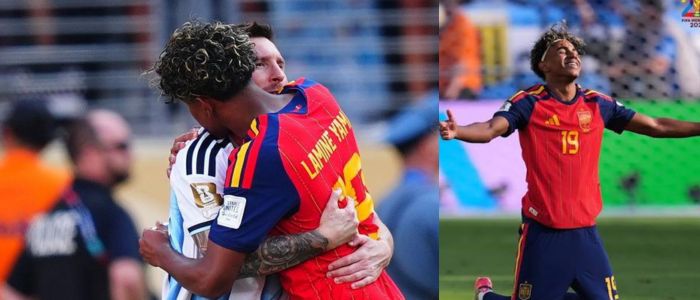
Ferran Torres struck the decisive goal in the 106th minute of extra time at New York New Jersey Stadium to seal a 1-0 victory and deliver Spain the World Cup. It capped a tournament in which the European champions grew steadily from a difficult opening draw against Cape Verde all the way to the summit of the game. Lamine Yamal, who arrived at the tournament managing a hamstring injury and took time to find his best form, ended it as the youngest player at 19 years and six days old to win both the World Cup and the European Championship, a combination no player his age had ever achieved before. He has now started 13 games at major tournaments for Spain and won every single one, giving him the longest 100 percent win rate of any European player in that context. He and 19-year-old teammate Pau Cubarsi also became only the fourth and fifth teenagers to start a World Cup final and finish on the winning side, joining Pele in 1958, Giuseppe Bergomi in 1982, and Kylian Mbappe in 2018.
How Spain Won and Why Argentina's Approach Cost Messi
Spain's victory was a triumph for football played the right way. Argentina's was not. From almost the opening whistle, the defending champions pursued a confrontational strategy that left their greatest player effectively sidelined and made the match uncomfortable to watch for long stretches. Messi, who had been so decisive in overpowering England in the semi-final, was barely involved as Argentina committed fouls at a rate that defied belief for a World Cup final. In the first half alone, Argentina committed more fouls in the opposition's final third than they managed passes in the same area, nine compared to eight. It was a statistic that told its own story.
Argentina became the first team in World Cup final history to fail to register a single shot across 90 minutes of the match. When they finally did attempt one, it came in the 117th minute when Messi fired off target with desperation growing. Spain, by contrast, put 12 shots on target across the match and controlled the game entirely. The low point of Argentina's approach came when Enzo Fernandez barged into Pau Cubarsi just before the match entered extra time, collecting a second yellow card that was fully deserved. After the final whistle, scenes deteriorated further as Leandro Paredes grabbed Eric Garcia by the throat and Gavi was thrown to the ground in a brawl involving players and officials from both sides. It was an undignified end to what had otherwise been an outstanding tournament.
Spain coach Luis de la Fuente praised Yamal with obvious sincerity after the match, describing his sacrifice for the collective and his maturity throughout the competition as qualities that would help him grow into an even greater footballer than he already is. Captain and player of the tournament Rodri has been central to that collective environment, and Yamal's ability to absorb experience from teammates of that quality gives his development an ideal foundation.
Messi's Farewell and What Comes Next
The contrast in fortunes between the two number 10s at the heart of the final could not have been starker. Yamal's joy was matched only by Messi's visible heartbreak. Argentina coach Lionel Scaloni, himself facing an expiring contract in December, broke down in tears when asked about Messi's future in the tournament after the final, leaving the press conference without completing his answer. Messi, who scored eight goals and added four assists at this World Cup to become the tournament's all-time leading scorer with 21 goals across his career, gave everything he had. Argentina's approach simply did not give him the platform his genius required, and that may be the most painful aspect of how his World Cup story has ended.
He turns 43 in 2030. A fourth World Cup is almost inconceivable. What felt like a conclusive final chapter in Qatar four years ago was extended remarkably to this New Jersey night, but now the curtain may truly have fallen on Messi's World Cup journey. Yamal, meanwhile, has his whole career in front of him. At 19, with a European Championship and a World Cup medal already secured, the years ahead belong to him. As one pundit watching from the sidelines put it simply and memorably: Lamine Yamal is 19 years old, and he has completed football.