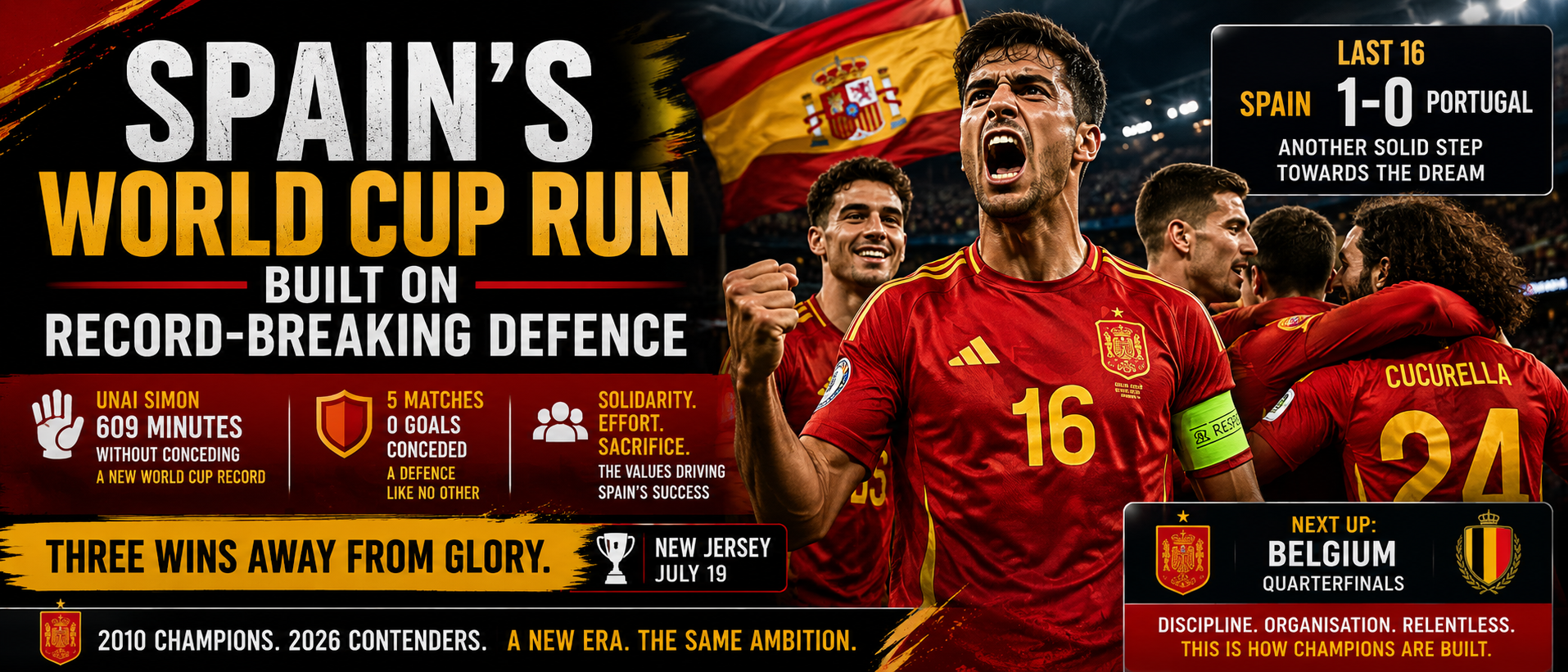
Spain coach Luis De La Fuente has built a team around the values of solidarity, effort, and sacrifice — words that perhaps do not generate as many headlines as a Bellingham bicycle kick or a Ronaldo moment, but are quietly winning matches at a major tournament. The results speak for themselves. Five matches were played. Not a single goal conceded. And at the centre of it all, goalkeeper Unai Simon is writing his name into World Cup history.
Simon's Record and the Defensive System Behind It
Simon extended his extraordinary run without conceding to 609 consecutive minutes at this World Cup after keeping Cristiano Ronaldo and the rest of the Portugal attack at bay in Dallas. That figure surpasses Walter Zenga's previous record of 517 consecutive scoreless minutes set by Italy, and also goes beyond the 476-minute benchmark set by Spain's own legendary goalkeeper Iker Casillas. What makes the record even more remarkable is that Simon has not needed to produce moments of individual brilliance to achieve it. Spain have defended so collectively and so intelligently that the goalkeeper has barely been asked to make the kind of miraculous stop that defines a tournament keeper's legacy. The clean sheets are a product of the system, not just the man between the posts.
In front of Simon, Aymeric Laporte and Pau Cubarsi have formed a central defensive partnership that expert analysts describe as perfectly suited to the way Spain want to play. They move the ball with confidence, drive forward when the opportunity presents itself, and defend the space behind them with real discipline. Pedro Porro and Marc Cucurella provide the attacking width from full-back positions, with Marcos Llorente having deputised for Porro in two of Spain's five matches. Anchoring the midfield ahead of this backline is Rodri, who has been in outstanding form. His ability to read the game, protect the defence, and distribute efficiently has made him the lighthouse of the team, as one observer described it — the figure around whom everything else is organised.
What Comes Next and How Far Spain Can Go
Spain's World Cup journey since 2010 has been far from straightforward. They retained the European Championship in 2012 but their subsequent World Cup campaigns brought consecutive group-stage exits before they fell in the first knockout round four years ago. The gap between that 2010 triumph and now has been marked more by disappointment than dominance at the global level. But arriving at this tournament as reigning European champions, with a squad that combines defensive organisation and attacking potential in roughly equal measure, Spain look like a genuinely complete team again.
Observers have noted that their display against Portugal was not their most spectacular, but that the absence of conceding a goal combined with a capacity to win ugly is arguably more ominous for opponents than a team that wins only when everything clicks perfectly. Spain faces Belgium in the quarterfinals on Friday, and if both Spain and France win their respective quarterfinal ties, a heavyweight semifinal between the two European giants awaits. Most agree Spain are capable of beating France, but that such a match would demand a near-perfect performance. For now, the focus is Belgium and keeping that extraordinary defensive record intact.