The occasion was enormous. US President Donald Trump arrived by helicopter before kickoff as part of a fleet of aircraft. Shakira, Madonna and Justin Bieber performed in the first ever World Cup half-time show, stretching a break that lasted 27 minutes. The atmosphere outside the stadium was extraordinary. Inside it, unfortunately, the football rarely matched the setting, with Argentina resorting to spoiling tactics that drained the match of any real rhythm and denied Lionel Messi the platform his genius deserved on what may have been his final World Cup stage.
How the Match Unfolded
The opening 90 minutes were more attritional than entertaining. Spain created the better opportunities, with Lamine Yamal and Mikel Oyarzabal each forcing saves out of Martinez in the first half. Argentina were physical and disruptive from early on, drawing persistent complaints from Spain about the leniency shown by Slovenian referee Slavko Vincic. Alexis Mac Allister's late challenge on Dani Olmo went unpunished, prompting audible sarcasm from Spain supporters inside the stadium. The first yellow card did not arrive until the 40th minute, when Lisandro Martinez brought down Oyarzabal, though the Manchester United defender went off injured shortly afterward.
The game boiled over in stoppage time. Enzo Fernandez, already cautioned, launched a reckless challenge on Spain's young defender Pau Cubarsi and received a second yellow card, leaving Argentina to face extra time with 10 men. Spain had been the better side throughout normal time and had Argentina's goalkeeper to thank for keeping the score level. Martinez made a superb late save from a Lamine Yamal free-kick that looked destined to find the net, and then produced another crucial stop from a Williams header. A Williams goal was also disallowed when substitute Mikel Merino was judged to have fouled Nicolas Otamendi in the buildup.
Extra time opened the game up. With the numerical advantage, Spain pushed forward with greater conviction, and it was Torres who finally broke Argentina's resistance in the 106th minute, turning Williams' header into the net with authority. Argentina, who had clawed back defeats against Egypt and England in the knockout rounds, could not find the same spirit of recovery here. They had barely threatened the Spain goal throughout the night, and the final whistle confirmed what the match had suggested almost from the start.
Spain's Journey, Argentina's Regret and Messi's Farewell
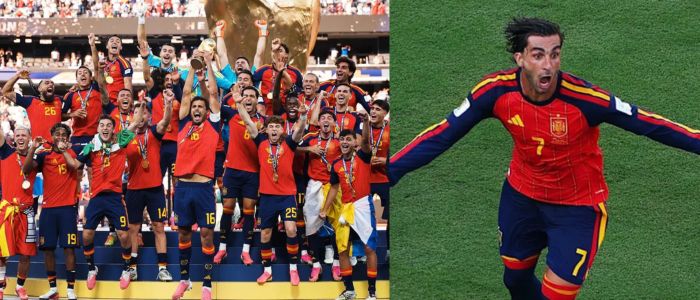
Spain's path to the title had begun uncertainly. A goalless draw against Cape Verde in their opening group game felt like a stumble, but coach Luis de la Fuente kept his composure and his team grew steadily in confidence and quality with every match that followed. They outclassed France in the semi-final and arrived at the final as deserving favourites. The decision to introduce Nico Williams from the bench gave them a different dimension in extra time and ultimately proved decisive. The victory also carries historic significance beyond the trophy itself. Spain became the first nation ever to hold the men's and women's World Cup titles simultaneously, a landmark achievement for football in that country.
For Argentina and Messi, the evening ended in quiet sorrow. The 39-year-old, who had been so influential throughout the tournament, finishing with eight goals and playing a key role in the semi-final win over England, was kept firmly at arm's length by Spain's organised defence. He managed just one shot all night, which did not trouble the goalkeeper. Argentina's choice to prioritise disruption over football did not serve Messi well, and in what may be his last World Cup appearance, he was left unable to influence events as the trophy passed to Spain. Coach Lionel Scaloni, visibly emotional after the final whistle, left a post-match press conference in tears when asked about Messi's future at the tournament. Argentina can have no real complaints about the outcome. Spain were better, played better, and fully deserved to be world champions.