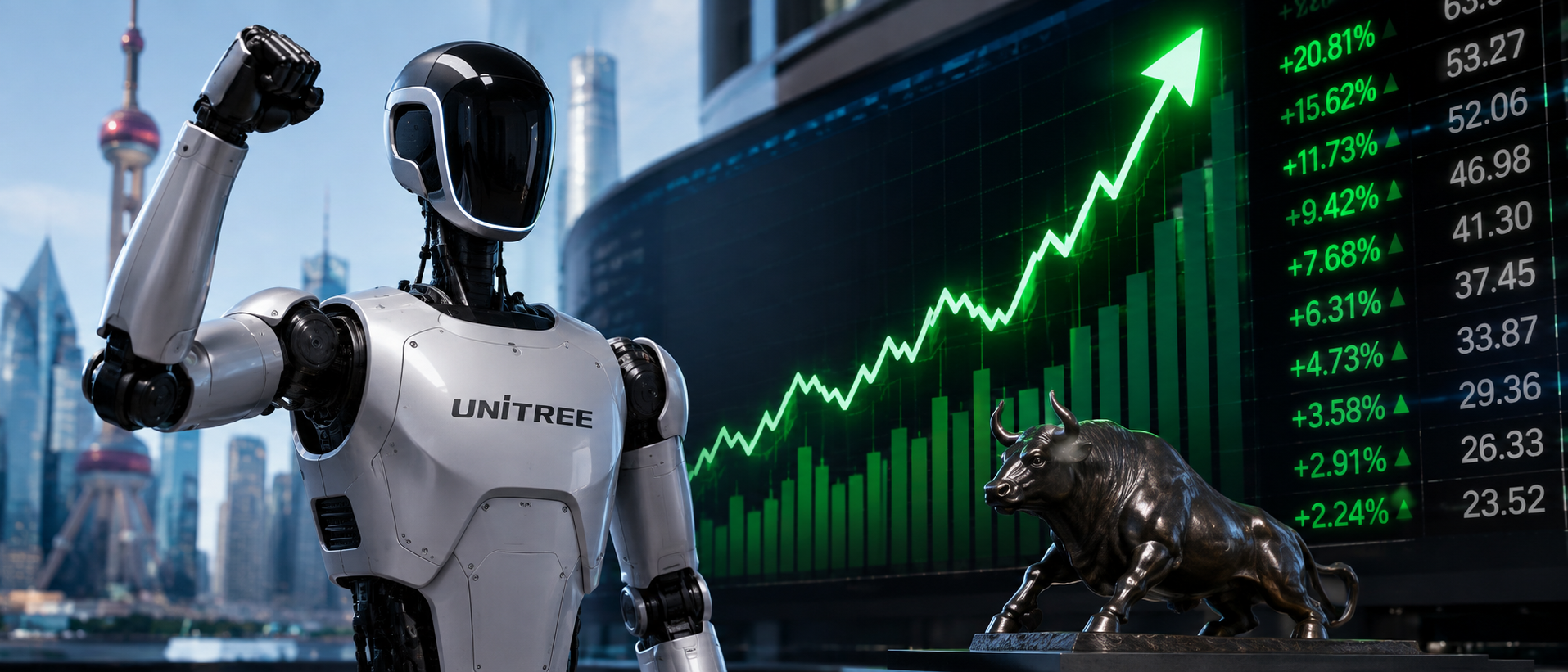
The listing took place on the Star Market, a technology-focused exchange often compared to America's Nasdaq, and represents a major moment for China's broader push to dominate the robotics industry. The debut arrives at a time when the US and China are locked in fierce competition over who leads the global race in robotics and the artificial intelligence systems that power them. While Unitree isn't the first Chinese humanoid robot company to go public, it is the first to list on a mainland Chinese exchange.
Who Is Unitree and Why It Matters
Founded in 2016 under the official name Yushu Technology Co Ltd, Unitree has grown into one of the leading names in robotics, producing everything from sensors and robotic arms to four-legged and humanoid machines. Last year alone, the company shipped more than 5,500 humanoid robots, reflecting rising global demand. Notably, Unitree stands out as one of the few profitable players in this space, posting a net profit of 278 million yuan in 2025.
The company has become a serious competitor to American robotics firms, offering machines with comparable capabilities at significantly lower price points. Based in Hangzhou, a city considered part of a robotics hotspot supported heavily by government funding, Unitree has benefited from a wave of state investment that helped triple the number of Chinese robotics companies between 2020 and 2024, according to figures reported by Chinese state media.
Robots are increasingly viewed as a possible fix for challenges tied to China's aging population, which is expected to shrink the available workforce in coming years, according to Fei Qin, an associate professor at the University of Bath. She noted that Beijing treats robotics as a top strategic priority, describing robots as the moment artificial intelligence moves beyond screens and into real-world settings like factories, hospitals, and eventually homes.
According to Harold Soh, a researcher at the National University of Singapore, American robots often come with more polished, user-friendly software, but the price gap with Chinese alternatives is hard to overlook. Unitree's robotic dogs start at around $2,700, a steep discount compared to the roughly $70,000 price tag attached to Boston Dynamics' four-legged robot, Spot. Soh noted that the comparison isn't perfectly even since some Unitree models are considerably smaller, but the price difference remains substantial.
Unitree began selling humanoid robots in 2023 and introduced its child-sized G1 model, priced at $13,500, the following year. Meanwhile, major American competitors, including Tesla, have yet to begin delivering similar products to market.
A Marketing Push and a Bellwether Moment
Ahead of its stock debut, Unitree leaned heavily into public marketing. This week, its robots are taking part in the 2026 World Humanoid Robot Games in Beijing, where hundreds of teams are competing in events ranging from running and soccer to more unusual challenges like opening boxes and sorting library books. Back in February, the company drew widespread attention when its G1 robots performed martial arts routines during China's Spring Festival Gala broadcast, a display robotics researcher David Hsu described as unlike anything seen before and a sign of the industry's rapid rise.
Investment experts believe Unitree's market performance could serve as an early signal of how much appetite investors have for the humanoid robotics sector. Jack Pearson of investment firm RoboStrategy said the listing gives everyday investors a rare opportunity to buy into a humanoid robotics company and could shape expectations for future listings. He also called the debut a turning point for China's robotics industry, especially given that it comes despite the US tightening restrictions on foreign-made robots.
Unitree's IPO follows roughly three years after smaller rival UBTech Robotics went public in Hong Kong. In July, UBTech made headlines with a robot Chinese state media described as offering emotional support and everyday companionship. Additional robotics firms, including Leju Robotics and AgiBot, are expected to pursue their own stock listings in the months ahead.
Despite the enthusiasm, some experts remain cautious about how much demand actually exists for robots beyond industrial and commercial use. Soh said robots capable of functioning reliably inside homes are still years away, pointing to unresolved issues like battery life, privacy protections, and overall dependability. For now, he said, the strongest market will likely remain factories and hospitals.
Robotics Becomes New Front in US-China Rivalry
Robotics and AI have emerged as a fresh flashpoint in tensions between Washington and Beijing, with both governments treating the sector as strategically vital. In July, the Trump administration announced plans to block new Chinese-made humanoid and quadruped robots, citing national security concerns and a desire to protect American manufacturing. Chinese officials pushed back, accusing the US of turning trade policy into a political weapon. Washington has already placed tight restrictions on other Chinese tech sectors, including AI systems and electric vehicles.
Christine Wan of the Peterson Institute for International Economics said China's growing dominance in robotics highlights a larger challenge for the US, as Chinese companies become increasingly embedded in global manufacturing supply chains. She noted that many countries may be hesitant to cut ties with Chinese suppliers for fear of disrupting their own manufacturing operations.
Western robotics firms, meanwhile, have yet to achieve the same level of impact on factory floors or in consumer markets. Boston Dynamics, majority-owned by Hyundai, has said it plans to introduce humanoid robots into Hyundai factories within the next two years. Other American companies, including Amazon and Tesla, have also outlined plans to bring humanoid robots into their operations. Tesla announced earlier this year that it would use its California manufacturing plant, previously used to build Model S and Model X vehicles, to produce its Optimus humanoid robot line. Amazon, which trialed humanoid robots in its warehouses back in 2023, said it continues researching next-generation robotics technology.
Robotics researcher David Hsu summed up the shift bluntly, saying American robotics companies rarely make headlines anymore, while Chinese firms have taken over that spotlight, effectively replacing the US as the industry's most talked-about innovators.