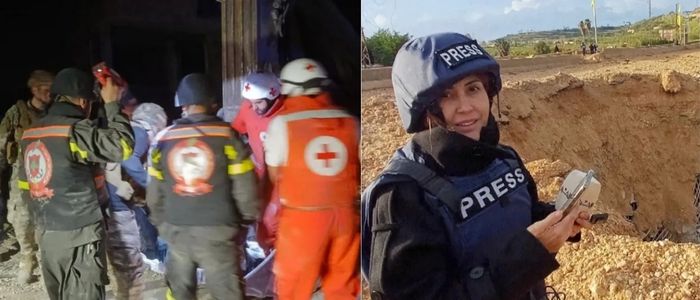
The other journalist, Zeinab Faraj, was an independent photographer. According to Lebanese officials, both journalists were housed in a place where they thought they would be safe. The first Israeli air strike destroyed the vehicle travelling in front of the two journalists, killing the two men in the vehicle. According to Lebanese officials, the two journalists then went into an adjoining house for safety and then the Israeli forces dropped a bomb on that house.
The location of the two journalists was previously known and the bombing was done with the intent to kill the two journalists. An ambulance from the Lebanese Red Cross attempted to help the two injured journalists, but when the ambulance arrived at the site of the bombing, Israeli forces fired stun grenades and bullets at the ambulance attempting to prevent the ambulance from getting to the two injured journalists.After being evacuated from the scene, Faraj had received medical treatment at different hospital resource centers for the deceased individuals, including Khalil.
These medical staff received additional information about a number of Peshmerga deaths as well, which are expected to provide evidence supporting Salam's statement that these acts constitute war crimes per international law. Urging a united front for a coordinated response to the actions taken by Israel, Salam expressed that he expected the international community to re-evaluate the treatment of wartime journalists and hold accountable all individuals responsible for committing such acts.
The IDF denied these allegations, insisting that it takes measures to minimize harm to members of the press and to uphold its obligations to protect its own soldiers during a time of combat. An official IDF statement indicated that the military was able to identify the two vehicles identified above based upon the fact that they were both linked in some way to a site used for military operations by Hezbollah.The military has claimed that one of the vehicles posed an imminent threat to Israeli forces after they crossed a forward defence line and this was deemed an act of violating the ceasefire agreement that was set in place.
The defences fired a missile at one of the vehicles and also at the structure that the people fleeing from the vehicle escaped from. The military has denied that it is preventing any ambulances from getting to this area, even though there are several reports of two journalists who were injured by the strike, but it has not officially stated that Amal Khalil is dead.
Reactions From Organizations Protecting Press Freedom
International organizations working to protect reporters expressed their condemnation of this incident immediately after it happened. Clayton Weimer, the Executive Director of Reporters Without Borders, confirmed that his organization sent messages to the IDF asking for ambulances to be allowed to get to Khalil and that the Red Cross reported that it could not get through because of ongoing shelling. Weimer stated that the circumstances show an extreme disregard for human life, and the evident targeted and deliberate killing of a journalist. The Committee to Protect Journalists stated that they were outraged by Khalil's death.
The Regional Director, Sara Qudah, stated that the killing of Khalil, repeated strikes on the same pattern, targeting of a site where journalists were located, and hindering access to medical aid from that site, is a serious breach of international humanitarian law.According to the International Federation of Journalists (IFJ), in 2024 Khalil reported that she had received an Israeli death threat, which was interpreted by press freedom advocates as further evidence of intentional targeting of journalists.
This trend is not isolated; it is a dangerous, ongoing pattern of intentional attacks against journalists. Two other journalists were also killed during separate Israeli bombing campaigns in Lebanon in April; one of whom (Ghada Dayekh) was a radio announcer at a privately owned radio station and the other (Suzan Khalil) was a television presenter for a Hezbollah-affiliated station. Furthermore, in the previous month, three Lebanese journalists were killed in an Israeli airstrike that specifically targeted them in Jezzine, Lebanon — Ali Shoeib (a Hezbollah-affiliated reporter), Fatima Ftouni (a female reporter), and her brother and cameraman Mohamed Ftouni.
The IDF acknowledged that it killed both Ali Shoeib and Mohamed Ftouni, stating on its website that both were members of Hezbollah's armed forces. The IDF further confirmed reports indicating that Fatima Ftouni was also killed. Lebanese President Joseph Aoun publicly referred to all three killings as unprecedented war crimes that violate international law because reporters are there carrying out their professional journalism dutiesAs stated by the Committee to Protect Journalists, at least seven journalists from Israel were killed as a result of Israeli attacks in Lebanon during the ongoing conflict.
Many More Have Died
The death toll caused by Israeli airstrikes on Lebanon has now exceeded 2,475 since the beginning of hostilities between Israel and Hizbollah in the latest round, and over 7,500 injuries have occurred from those Israeli attacks, according to the Lebanese government. The death figures also included approximately (not including; only approximate) 274 women and 177 children, (and the death figures do not identify whether they had civilian or combatant status).
Last week, the Lebanese health ministry also reported that there are at least 100 deceased medical personnel due to Israeli airstrikes in Lebanon during the current hostilities and over 120 reported strikes on ambulances/medical facilities. From the Israeli side, two Israeli civilians have been reported as having been killed by Hizbollah since the beginning of the current hostilities, and 13 Israeli defense forces have been KIA in combat in Lebanon. There have been accusations by both Israel and Hizbollah against each other of violating the cease-fire agreement from the war.
Continued Diplomatic Initiatives
Despite the violence occurring in the region during the current hostilities, continued diplomatic efforts are still being made to try to establish some level of peace within Lebanon and Israel.The last time that either of the Lebanese or the Israelis had any direct high level intelligence was three decades ago at a meeting hosted by United States Secretary of State Marco Rubio. After this meeting, the two governments agreed to a ten-day ceasefire in order to allow time for the two countries to arrange a permanent security and peace agreement. After the meeting, President Aoun confirmed plans for an extension of the ceasefire period by requesting formal approval of a one-month extension.
President Aoun also outlined his government's negotiating positions relating to recognition of Lebanon's sovereignty over its entire land, a cessation of Israeli attacks against Lebanon, an exit of Israeli military personnel from Lebanon, release of Lebanese nationals detained in Israeli prisons, deployment of Lebanese military units at the Lebanese border with Israel and initiation of a reconstruction process. Israel's foreign minister addressed Israeli diplomats and characterized the situation between the two countries as an opportunity to cooperate against what he characterized as an international terrorist network established by Hezbollah.
Remembering Amal Khalil
Those journalists who knew Amal Khalil remember her for her commitment to performing her civic duty by reporting truthfully on the humanitarian crisis in southern Lebanon. Al-Akhbar, the newspaper Khalil worked for, published an obituary describing Khalil as a person who maintained her humanitarian and professional commitment regardless of the danger posed by being a journalist reporting on the effects of the ongoing Israeli-Lebanese conflict.
A journalist who covered the Middle East and who had encountered Khalil in the field described her as being thoroughly professional, as well as warm and kind, and to have earned the respect of her peers. Khalil's death at age 43 has created a tremendous loss in the community of journalists committed to chronicling one of the world's most dangerous and consequential military conflicts.