"We have many, many bad people inside our unit, inside the state, inside politics," he says. "We have many, many guys that are corrupt. They are in the pay of the gangs." The only officers he truly trusts are the small, handpicked team that moves with him every day. At 34, Bustamante is the oldest of the group, and his background as a former special forces soldier still shows in the way he carries himself.
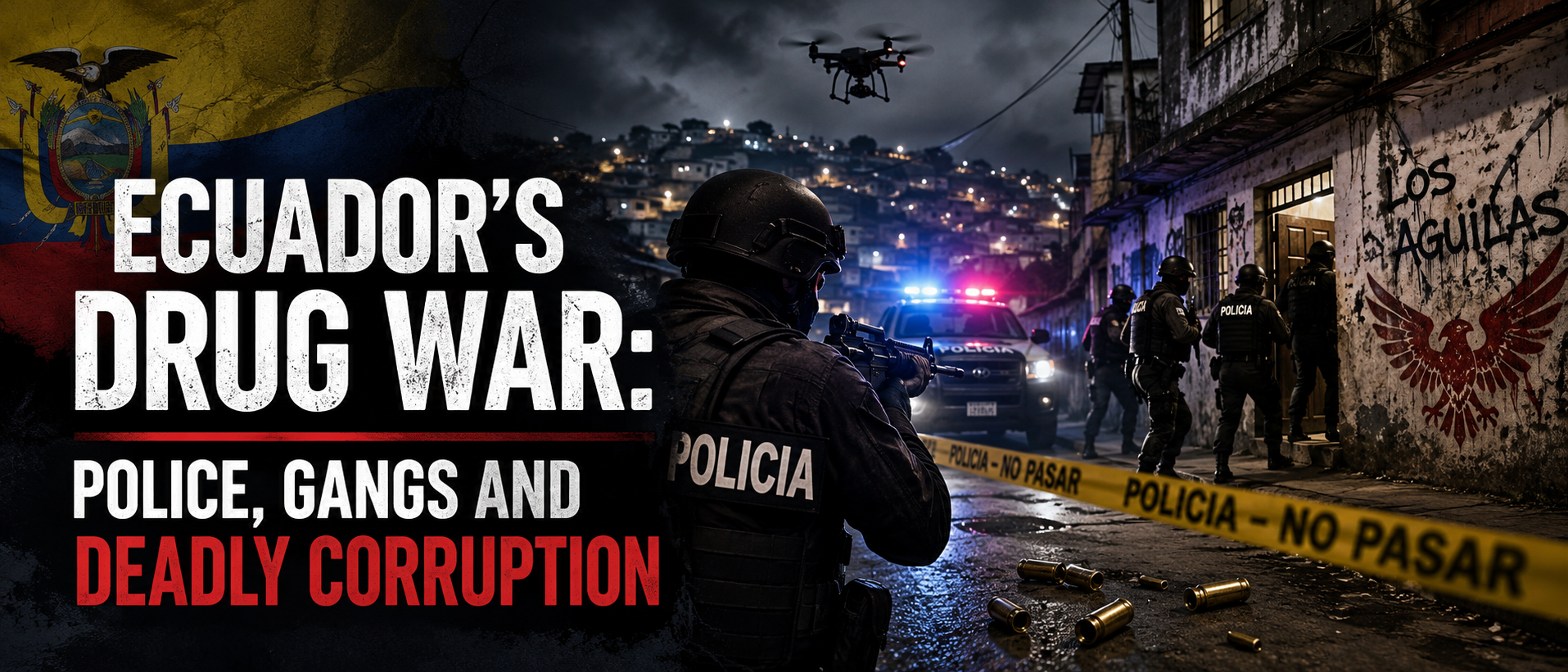
As evening falls, he leads his unit into a rough part of town where windows are covered with metal grilles and residents keep their mouths shut out of fear. This is territory ruled by a gang known as Los Aguilas, "The Eagles." Ask locals what happens if they speak against the gang, and the answer is simple and chilling: they get killed. That is why nobody talks.
A Neighbourhood Raid and a War With No End in Sight
Bustamante's target that evening is an abandoned house where he suspects weapons are hidden, since gunmen rarely keep firearms at home. His team stacks up against the wall, weapons ready, before breaking the door down with a battering ram. Inside, they find two handguns, one rusted and unusable, the other loaded and ready to fire, along with ammunition for an assault rifle.
It is a small win, and the captain knows it. "The first reason is because we are safe," he says. "The second is that there are two guns less for the gangs." He is blunt about the scale of the problem, admitting the gangs have far more weapons and money than the state does.
He has already lost three close friends in this fight and says he stopped being afraid years ago. His parents have not. His mother tells him to be careful, warning he could die out there. His father calls constantly, just to ask if he is safe.
The bigger picture explains why this fight matters far beyond Ecuador's borders. According to President Daniel Noboa, roughly 70 percent of the cocaine reaching Europe and the United States now passes through Ecuador. Cocaine produced in neighbouring Colombia and Peru, the world's two largest producers, moves through Ecuador with the help of local gangs that have built ties to Mexican cartels and Albanian criminal networks. Weak border security, underfunded police forces and a long, exposed Pacific coastline have made the country an easy transit route.
The change has been fast and brutal. A country once known as a quiet tourist destination has, in less than ten years, turned into one of the most violent places in the region. Last year alone, more than 9,200 people were killed, according to Ecuador's interior ministry, giving the country one of the highest murder rates anywhere in the world. This is despite two years of a tough security crackdown under President Noboa. Critics argue the approach has actually made things worse, since arresting top crime bosses has caused gangs to splinter into smaller, more numerous groups rather than disappear.
Many people in Durán no longer believe this war can be won. Bustamante keeps going anyway.
During another operation, he watches a playground area through a drone camera and spots three men he believes are low-level street dealers, the smallest link in the drug chain, selling in tiny quantities rather than bulk. Within minutes, his team traces them to a nearby house. The battering ram comes out again. Inside a dark kitchen, lit only by torchlight because there is no electricity, a woman protests loudly while a young girl cries nearby.
Officers search room by room, checking wardrobes and lifting mattresses. Upstairs, they discover a hiding spot behind a window and pull out a young suspect. Two more people are handcuffed elsewhere in the house. All three deny selling drugs as they are led away. Nearby, the captain finds small paper packets of a drug locally called "H," a cheap and addictive mixture containing traces of heroin, sold to street users for around one dollar (roughly 75 pence) per packet.
Only one of the three suspects is formally charged, facing up to five years in prison if convicted. The other two are released by prosecutors. Senior police officers say this pattern repeats constantly and blame corruption running through the justice system.
Bribes, Corruption and a Justice System Gangs Can Buy
Colonel Santiago Gavilanes, deputy commander of Durán's police force, describes a frustrating cycle. "We imprison them and they release them," he says of gang members caught during raids. "We know because when we carry out raids, we recapture them. Some of those who are released kill people and leave orphans behind." He says gangs have enough money to buy laws, judges and politicians outright.
That buying power becomes personal for one officer interviewed separately, whose identity and location cannot be revealed for his own safety. He describes being contacted twice by text message and offered an enormous bribe, enough, he says, to retire on for life. He refused. Someone inside the force, possibly a colleague, had already told the gang exactly where he worked and what his job involved. "You never know who is watching," he said, a phrase echoed by several officers during the reporting period.
By the end of another long shift in body armour near the playground, Bustamante admits he is tired, but insists giving up is not an option. "Maybe I am a little tired," he says, "but it's my work. I believe we can win this war. We have to do it." Even as he speaks, word comes that a local gang boss is nearby. Officers know the man controls area dealers, but without solid evidence, they cannot make an arrest.
Despite the grim numbers nationally, police in Durán insist their efforts are paying off locally. They say the murder rate in the city has fallen by half over the first six months of this year. Streets that used to empty out by early evening now stay active past 7 p.m., and the beheadings and dismemberments that were once disturbingly common have become rare. "We have managed to contain the gangs," Colonel Gavilanes says. "Getting complete control is going to be a medium-term process."
Meeting the Enemy: A Gang Leader's Side of the Story
Outside the city, roughly an hour's drive away, a different picture emerges from the other side of the conflict. A local gang leader, identified only as Jonathan for safety reasons, claims to have four police officers on his payroll. "Whenever they're going to do an operation, they call me," he says. "They tell me to hide things, and to get out of here. When they arrive, they find nothing." He pays between 1,500 and 2,000 dollars (roughly 1,100 to 1,500 pounds) a month for that advance warning.
At 37, Jonathan is only a few years older than Captain Bustamante, but stands firmly on the opposite side of the law. He says he joined a gang at 18 simply to survive and put food on the table. He and his men, several of them still teenagers, walk openly through the streets in daylight carrying weapons, including a semi-automatic rifle and a handgun. Among them is a 17-year-old wearing a bulletproof vest and flip-flops. All of them keep their faces covered.
Speaking inside a cramped room in a small breeze-block house, with his lieutenants crowded around a bed that fills most of the space, Jonathan admits openly to dealing drugs and killing people. Asked how many lives he has taken, he answers casually, guessing around eight, adding he does not remember the exact number, all while holding a handgun in his lap. He insists his gang does not target innocent people, only rival groups trying to take over their turf, framing the violence as self-defence against invaders.
Children gather near the doorway as the conversation continues. Human rights workers in Ecuador say boys can be pulled into gang life as young as 12, and by 15 some are already carrying out killings. Jonathan shows no regret about arming teenagers or selling cocaine in the very community he claims to protect. He believes the drug trade can never truly be stopped, arguing that shutting down one gang simply makes room for another to take its place. He expects to die violently himself one day but says he will not go down without a fight.
Two nights later, back in Durán, the human cost becomes visible again. A man's body lies beside a motorbike, lit by flashing police lights, bullet casings scattered nearby. Neighbours watch mostly in silence while a man and woman, relatives of the victim, hold each other and weep. Police suspect the killing was gang retaliation. Forensic workers carry the body to a refrigerated van that already holds another corpse from earlier that day.
A witness, who also asked not to be named, describes the shooting in blunt detail: the victim was already wounded when he fell, then shot again in the head, hit six times in total by two men on a motorbike. "We are used to this now because it happens every day," he says quietly. "You might just step outside and catch a stray bullet. You can't even go out or talk to friends or family because someone could shoot you." He does not believe the president's crackdown will change anything. Criminals, he says, are like ghosts, appearing wherever they please, before disappearing again into the night.