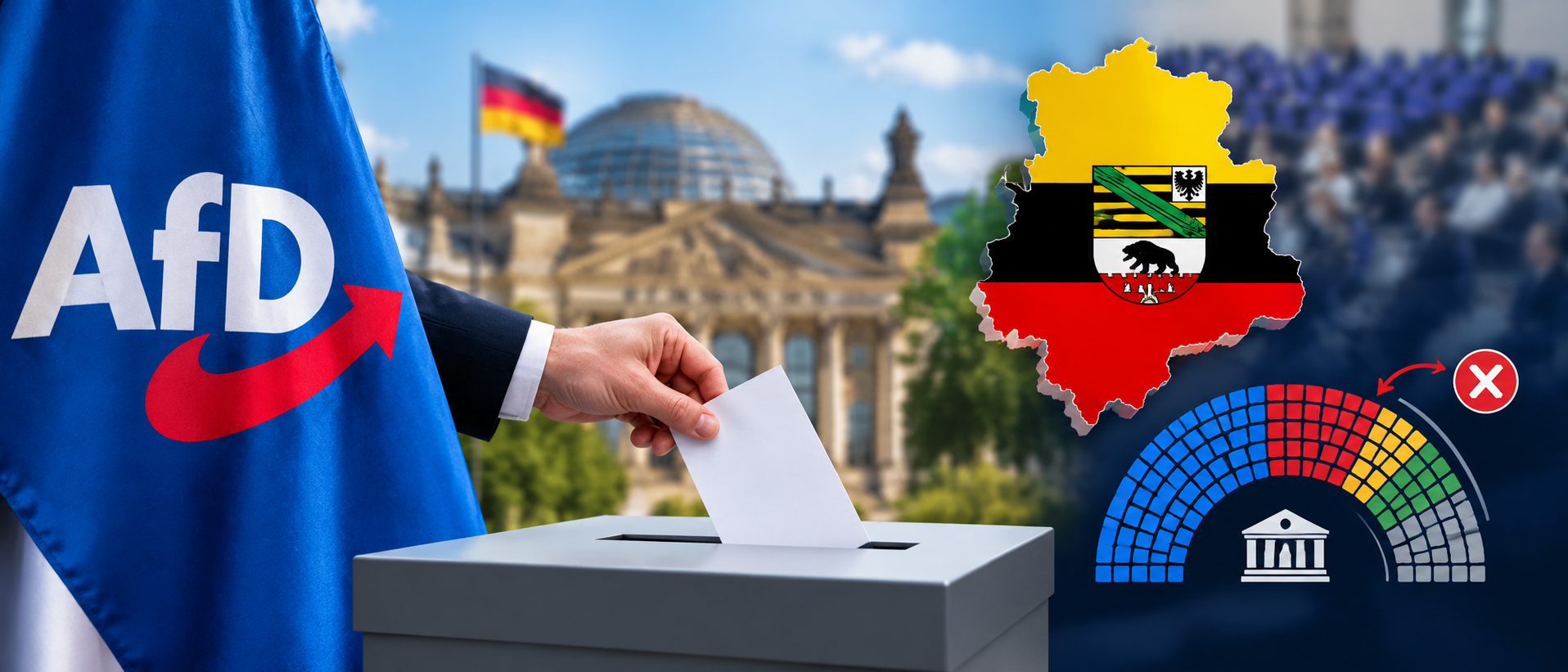
Ulrich Siegmund, the AfD's leader in Saxony-Anhalt, called the result sensational, arguing that the party had earned a clear mandate to lead the state. No far-right party has controlled a German state since World War Two, and doing so would grant significant authority over local policing, education, and cultural policy. Saxony-Anhalt has a relatively small population of 2.1 million, and the state's domestic intelligence agency currently classifies the local AfD branch as right-wing extremist, a label the 35-year-old Siegmund firmly rejects. Alongside national co-leaders Alice Weidel and Tino Chrupalla, Siegmund celebrated as early projections showed the party more than doubling its 2021 result.
AfD Falls Just Short of Outright Control
Based on current projections, the AfD is set to win 39 seats in the state's 83-seat parliament, just three seats shy of a governing majority. Siegmund has stated he has no intention of leading a minority government, even though the party's national leadership views that as a possible path forward. He suggested that if necessary, fresh elections could be called instead, predicting the party could climb to 50 or 55% support, while noting he remains open to cooperating with individual lawmakers or smaller parties.
One possibility being discussed involves the left-wing populist BSW party, projected to win five seats, offering informal support that could allow the AfD to govern as a minority. The BSW shares the AfD's tough stance on migration and also supports importing Russian gas. While the AfD has expressed openness to talks with other parties, every major party except the BSW continues to refuse cooperation with the far-right group. Beatrix von Storch, the AfD's deputy parliamentary leader, told reporters her party plans to pursue talks aimed at winning support from individual lawmakers in other parties, including members of the CDU's own parliamentary group who she claimed are deeply unhappy with their party's direction. She warned that parties refusing to work with the AfD and disregarding the will of voters risk triggering serious political chaos and new elections. A messy CDU-led minority coalition remains theoretically possible but appears highly unlikely at this stage.
Reaction Pours In From Germany and Abroad
Political analysts and opponents alike described the result as a watershed moment and a clear break from the past. Germany's major broadcaster Das Erste even canceled its long-running crime drama Tatort to provide extended coverage of the election outcome. Siegmund told supporters the result carried significance far beyond Saxony-Anhalt, calling it a confident signal for the entire country.
The result quickly drew international attention. US President Donald Trump shared a screenshot of German election projections on his Truth Social platform, and Russian presidential envoy Kirill Dmitriev reposted it, praising what he called a historic win for the AfD. Dmitriev had previously described the Russia-friendly party as a symbol of hope, reason, and cooperation for Germany. Ahead of last year's German federal election, US Vice President JD Vance had also publicly endorsed the AfD, a move widely criticized within Germany as foreign political interference. Polish Prime Minister Donald Tusk offered a starkly different reaction, stating that in Poland, only fools or traitors would celebrate an AfD victory.
At the AfD's election night headquarters, supporters erupted in cheers as results appeared on screen, with the crowd later breaking into Germany's national anthem. Siegmund declared that history had been made in the state. CDU state leader Sven Schulze conceded defeat as his party's vote share dropped by more than half compared to the previous election, calling the campaign extremely tough and intense while acknowledging his party would need to reckon with the outcome. Germany's center-left SPD called the result truly dramatic, with national leader Lars Klingbeil, whose party currently governs nationally alongside the CDU, describing it as a clear signal to Berlin that could not be ignored.
Voter turnout in Saxony-Anhalt reached a notably high 77.8%. Supporters in Magdeburg praised Siegmund's ability to connect with voters. One supporter, Ollie, said the AfD offers something no other party provides, describing it as a party focused on working people rather than empty promises. Another voter, Bert, said residents in eastern Germany sense things aren't improving, expressing fear over declining safety and a desire for better conditions for his three children.
Nationally, the AfD currently leads opinion polls ahead of Chancellor Friedrich Merz's ruling conservatives and the Social Democrats, though its strongest support remains concentrated in eastern Germany. The party also won the 2024 state election in neighboring Thuringia but fell short of securing enough seats to govern there as well.
Among the AfD's most controversial policies is its plan for so-called "remigration," widely understood to involve mass deportations of migrants, though the party insists it refers only to deporting criminals and those residing in the country illegally. Even with a state-level win, the party would lack the authority to implement such a policy fully, though it would gain considerable local influence. The AfD has also been sharply critical of the Bauhaus design school, which the Nazi regime shut down in Dessau, located in Saxony-Anhalt, after seizing power in 1933. The party has referred to the movement as a dead end of modernism, language some critics say echoes Nazi-era rhetoric.
At a Democracy Festival protest held in Magdeburg the night before the vote, a demonstrator named Nikita said Germans must learn from their history rather than repeat it, stating that the country does not want a return to darker times. Reacting to the results, Charlotte Knobloch, longtime head of the Jewish community in Munich and Bavaria and a 93-year-old Holocaust survivor, said the outcome frightened her, admitting she sometimes struggles to recognize her own homeland and calling on mainstream parties not to allow further decline.
Separately, senior AfD figure Hans-Thomas Tillschneider in Saxony-Anhalt faced criticism over his stance on Russia after being asked about a Russian army mug displayed in his office, which he dismissed as a simple souvenir, adding that the ongoing conflict was not Germany's war.