What Caused the Explosion?
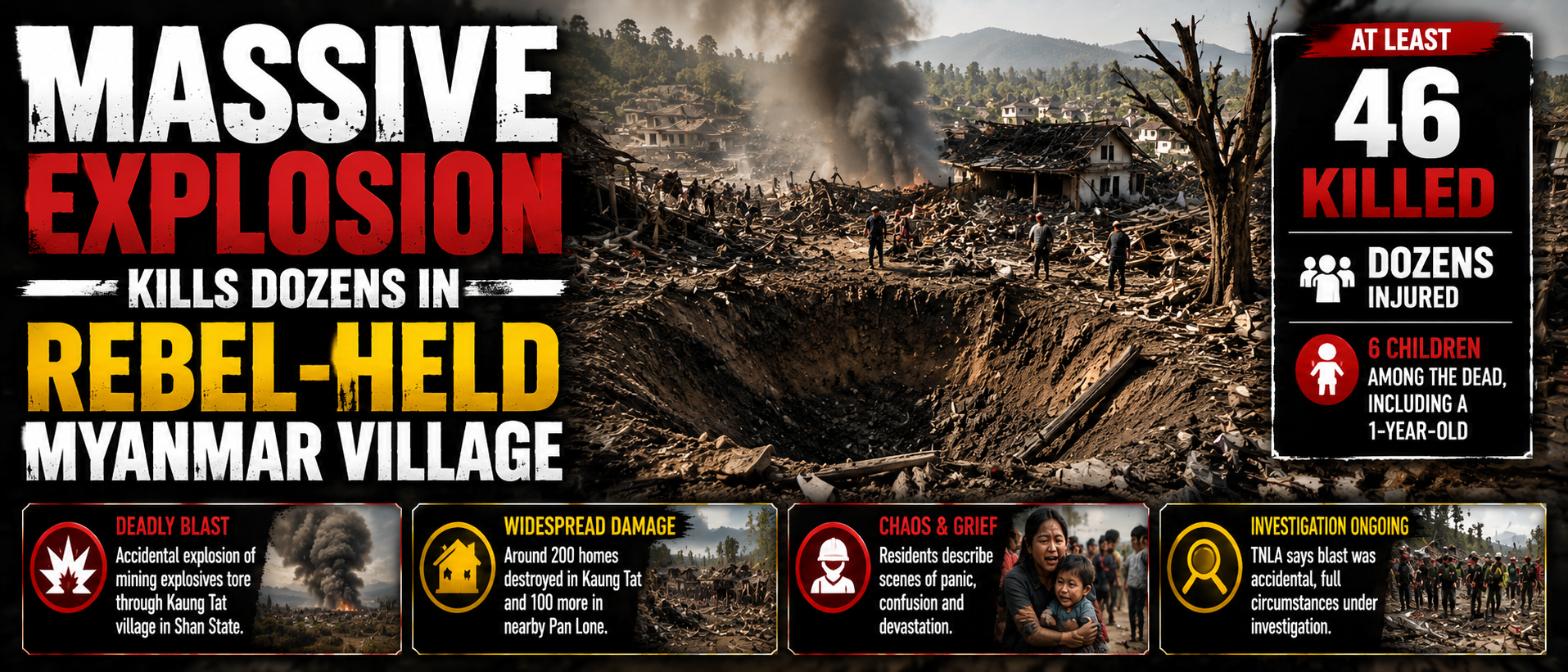
The insurgent group controlling the area, the Ta'ang National Liberation Army, which has been in armed conflict with Myanmar's military junta, called the incident an accidental explosion around noon local time on Sunday. The blast was from the detonation of explosives used in mining and quarrying operations in the area, a statement from the group said. The blast tore through the village with great force, damaging about 200 homes in Kaung Tat and another 100 homes in the nearby village of Pan Lone. Without giving details of the circumstances behind the blast, the group said many local villagers were killed, injured, and their homes damaged.
Images of devastation
The destruction wrought by the explosion was evident in footage from the scene. By the time the cameras arrived, the scene of the blast was dominated by a huge crater of earth and rubble. Around it stood broken buildings, blackened debris, and gnarled trees, with smoke still billowing up from the wreckage. Residents described scenes of widespread devastation and confusion immediately after the explosion, with many initially believing the blast to have been caused by a military air strike, given the enormous force of the detonation. One resident wrote on social media that children were among the dead and that hundreds of homes were damaged, affecting almost a whole neighbourhood. She wrote that she was eating noodles and looking at her phone in her bedroom, not the kitchen, where she would probably not have survived. She said she had been nearly killed.
Panic and grief in the aftermath
Survivors described the scene immediately after the explosion as one of overwhelming grief and confusion. People were crying and calling their parents in the chaos after the blast, wrote the resident, who posted her account on social media. "It was like the end of the world," she said. She said she had a slight injury to her leg and that her own home had been destroyed. She asked pointed questions about why a facility containing explosives had been allowed to operate so close to residential areas, as well as expressing personal grief, saying the families of those killed would not be satisfied unless authorities gave a full and transparent explanation of how the situation had been allowed to arise.
Mining and Safety in Rebel-Controlled Areas
The explosion has highlighted the broader problem of safety in mining in parts of Myanmar under the control of armed ethnic groups. The extraction of precious minerals is a major source of funding for many of the country's rebel organizations in their military campaigns, and mine collapses and unplanned detonations are recurring problems in the affected areas due to lax safety standards in mining and quarrying operations. The Ta'ang National Liberation Army is regarded as one of the most powerful ethnic armed groups still fighting Myanmar's military junta, and its area in Shan State has been a hotbed of the country's decades-old internal war. The presence of large quantities of mining explosives near residential communities exemplifies the harsh and often dangerous realities of life in areas where armed groups exercise administrative control outside of the authority of national safety regulations.
Death Toll Increases, Investigation Ongoing
The Ta'ang National Liberation Army said the explosion was an accident caused by mining explosives, but that the full circumstances remain under investigation. At the time of reporting, 46 people were reported dead by rescuers, but a source familiar with the situation on the ground said the real number may be closer to 55 as rescue operations went on and more victims were found in the rubble. The international community and human rights observers will be watching closely to see whether a credible and transparent accounting of the incident is provided, especially in light of concerns raised by survivors over the proximity of dangerous industrial operations to civilian homes and the adequacy of safety oversight in the affected area.