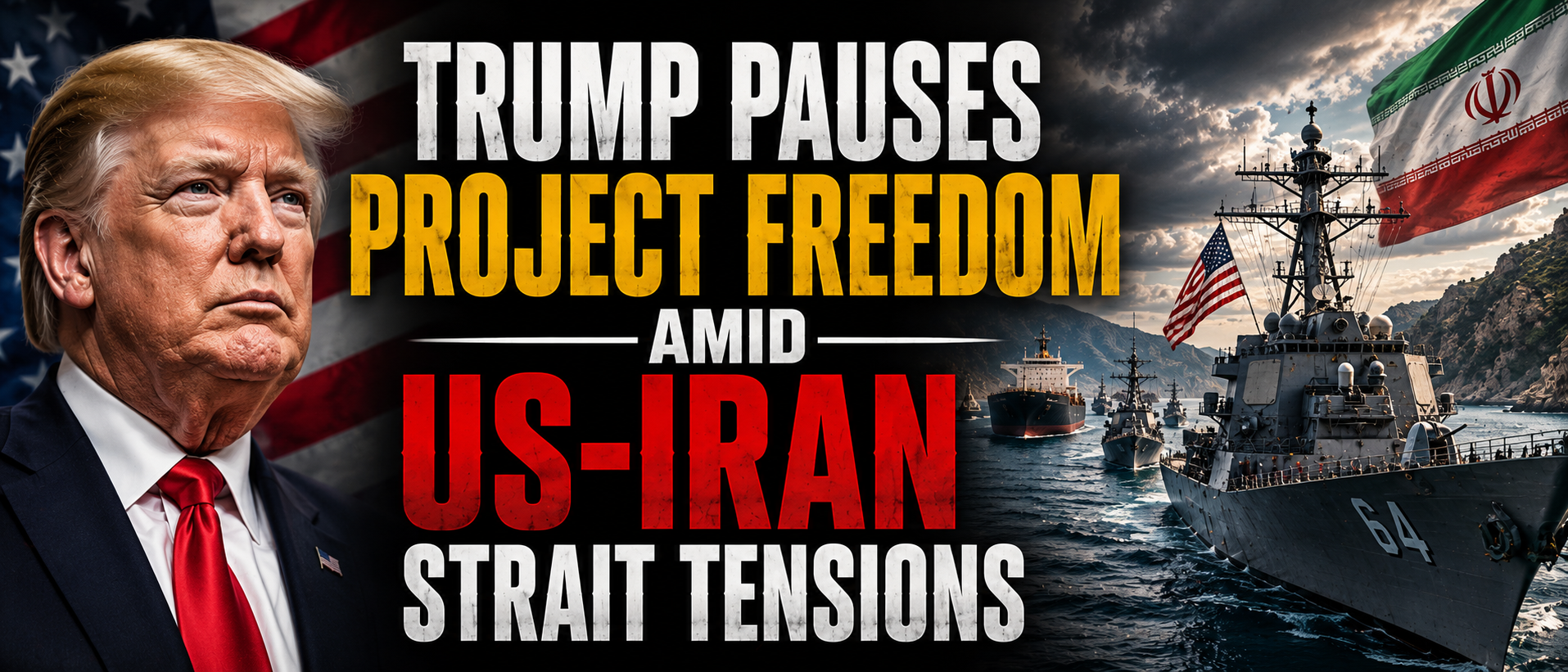
Trump announced the plan on a Sunday; however, after only two days of being announced, it was suspended for a short time to give the United States and Iran a chance to negotiate an agreement. Trump stated that Project Freedom was a humanitarian effort to free harmed parties including people, companies and countries who hadn't committed any offences.
Iran took a different view, claiming that no ship can cross that waterway without specific permission from Iran and would therefore create a significant and dangerous standoff between the US and Iran.
The Gulf Crisis
The Strait of Hormuz has been almost completely shut down since Israel and the United States attacked Iran with air strikes on February 28, 2013, resulting in Iran closing the Strait of Hormuz, which normally handles 20% of the worldwide oil and liquefied natural gas. According to the US Central Command (Centcom), approximately 22,500 men are currently on approximately 1,550 different commercial vessels in the Gulf. There are currently vessels from 87 countries in the Gulf (Admiral Brad Cooper, Centcom Commander).
With the growing concerns regarding the diminishing supply and the deteriorating physical and mental health of thousands of seafarers in the Gulf, the Central Command of the United States has dispatched seven ships operated through missile-guided systems along with over a hundred aircraft to assist the United States military presence in the region in an effort to provide the U.S. Navy with over 15000 military personnel stationed in the region.
Limited operational success and significant levels of uncertainty were identified at the outset of the campaign. The first confirmed "USS" (United States Shipping) transit of trading ships through the Strait of Hormuz was confirmed by the Central Command, as well as several confirmed USS merchant vessels departing the Persian Gulf with U.S. naval force support; however, General Order No. 1 (GO1) barring two vessels was confirmed as failed operations based upon the Iranian Revolutionary Guard Corps' (IRGC) assertion indicating, along other trade routes, that at least two U.S. merchant ships were lost during the operation.
(Tim Wilkins) said that the Trump Administration (U.S. government representatives) did not develop a coordinated way to provide all of their independent members with a formal methodology to facilitate safe passage through the STRAITS. This left most members in a state of apprehension over whether their ships would be provided for any protection against future attempts to transit the STRAITS.
Hours after the initiation of Project Freedom, the Iranian Armed Forces (IAF) claimed to have attacked United States and Israeli military trading vessels; however, the Central Command denied any navy trading vessels were lost during those attacks. Additionally, the Central Command reported that the IAF fired cruise missiles targeting U.S.
Navy trading vessels and U.S. merchant vessels during the day of the operations against U.S. vessels. (IAF and U.S. Navy-operated) drones were also employed against merchant vessels on the same date. As an example: An ADNOC (United Arab Emirates government-controlled regular supply of crude oil) trading vessel received drone capability targeting the vessel while in transit. Also, a South Korean trading vessel was attacked by the IAF while offshore of the United Arab Emirates; no injuries were reported.
In total, six small IAF vessels were reported sunk via U.S. helicopter drill boats engaged in suspected attacks against merchant vessels. However, the Iranian government denies U.S. military reports and claims that they will take extreme measures against vessels that do not follow the approved IAF transiting vessel routes through the STRAITS.
Stalemate, Discussions, and threats escalate to wider conflicts. President Trump suspended Project Freedom upon Pakistan's request in support of negotiations between the U.S. and Iran; he stated that the ceasefire will not change the status of the STRAITS. Iranian government sources stated that both the Iranian and U.S. close collaboration in efforts to return peaceful access to the STRAITS was an indicator that President Trump failed once again.
The U.S. Secretary of Defense, Hegseth, confirmed that the ceasefire and Project Freedom would no longer be supported relative to military operations; this was a separate military operation as the operations of Project Freedom were conducted.
The level of optimism is marginal at best. (Grant Rumley), military trade advisor to the governments of both Old and New Era; reaffirms that continued world trading on the seas will be immeasurable in terms of long-term impacts. Chatham House Fellow, Nitya Labh, stated; "Project Freedom will only take a little while to resume massive escalation of military operations".
Free trade through the STRAITS is a long term requirement that will need long-term commitment and commitment to safe passage through the STRAITS, one of the most important trading waterways in the world.