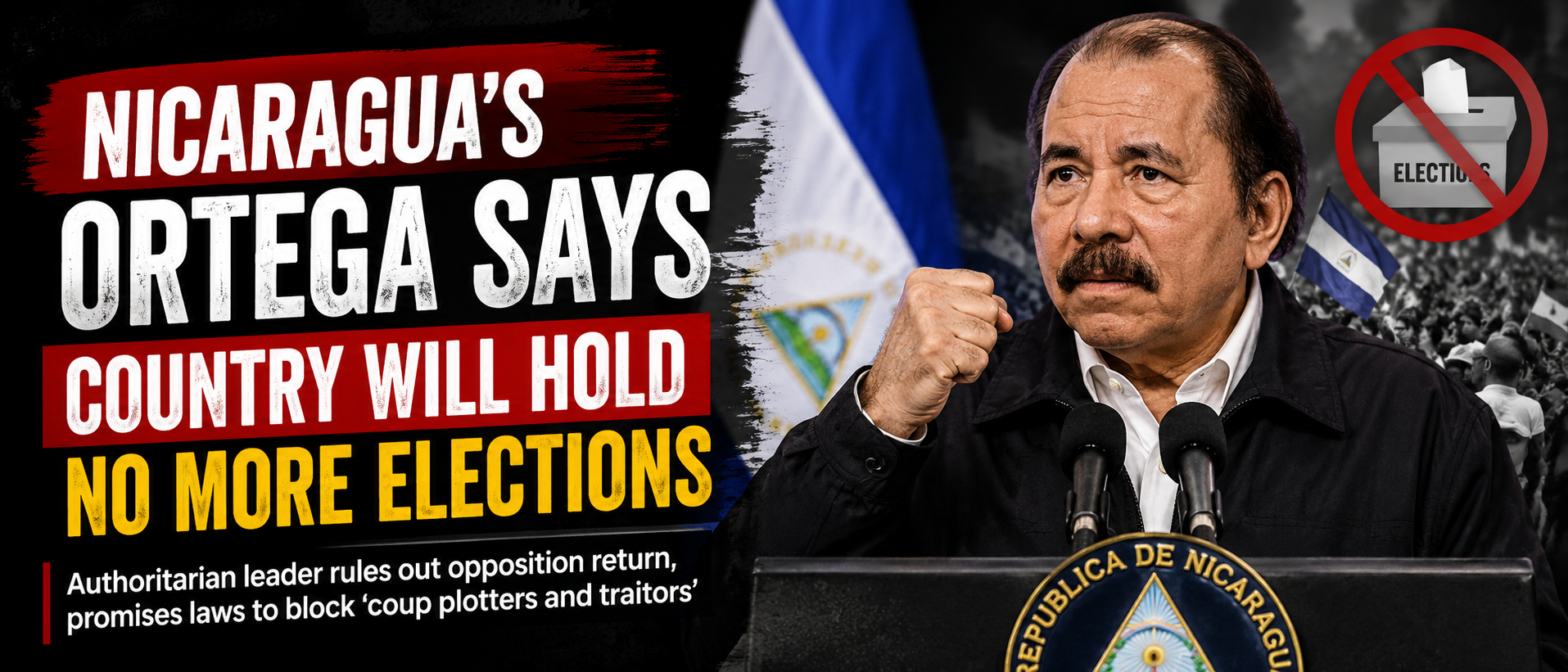
The statement marked a significant rhetorical escalation even for a leader whose administration, shared with his wife and officially designated co-president Rosario Murillo, had already been characterised by a years-long erosion of democratic institutions. For analysts watching the region, it was a moment that removed any remaining ambiguity about where Nicaragua was heading. Tiziano Breda, a Latin America senior analyst at Armed Conflict Location and Event Data, described the announcement as sealing the country's transition to a full-fledged family dictatorship.
Ortega had not appeared in public for 61 days before Sunday's address. His audience was reportedly composed largely of state employees who, according to local media, had been compelled to attend. Speaking before that crowd, he stated plainly that there would be no more elections that might allow opposition parties to attempt to seize government or take power. He said new laws were needed at the institutional level to erect a permanent barrier against those he identified as threats to his administration. Elections had been scheduled for next year, though Ortega offered no specific detail on whether they would be formally cancelled or whether opposition participation would simply be prohibited outright, as it effectively was during the 2021 campaign when his regime outlawed rival parties and imprisoned all opposition presidential candidates.
The Deepening Grip on Power
Ortega's consolidation of control has been methodical and relentless. Last year, he pushed through a package of constitutional reforms that extended the presidential term from five to six years. The same reforms elevated Murillo, his wife and former vice-president, to the formal position of co-president. The United States government refers to their joint administration as the Murillo-Ortega dictatorship. During Sunday's speech, Ortega also commented on the US operation in January that resulted in the abduction of Venezuelan leader Nicolás Maduro, condemning it as monstrous and expressing solidarity with Maduro and his wife.
He framed his decision to eliminate electoral competition as a necessary defence against the forces he claimed were behind the nationwide protests of 2018. Those protests were met with a violent crackdown by his regime that, according to organisations including the United Nations, resulted in the deaths of more than 350 people, the wounding of hundreds, the imprisonment of thousands, and the forced exile of nearly one million Nicaraguans. Ortega has long characterised that crackdown as a legitimate response to an attempted coup orchestrated by foreign-backed opposition groups rather than as the suppression of popular dissent.
The Human Cost and International Response
The state of civil society and human rights in Nicaragua has drawn sustained condemnation from the international community. According to Human Rights Watch and other organisations, approximately 50 political prisoners remain in detention in the country. Since Ortega's administration began tightening its grip, 546 people have been stripped of their citizenship. More than 5,600 non-governmental organisations have been shut down, along with 29 universities and 58 media outlets. The deliberate dismantling of independent institutions has left very little space for dissent or public accountability of any kind.
Recently, the United Nations, the United States, international human rights bodies, and 30 former Ibero-American presidents jointly attributed responsibility to Ortega and Murillo for the death of Indigenous leader and four-term congressman Brooklyn Rivera, who was 73 and had spent nearly three years in detention under the regime before his death. The US State Department described his imprisonment as unjust. Analysts suggest that Sunday's announcement reflects not a position of strength but one of increasing anxiety, with Breda noting that Ortega and Murillo appeared to fear that even a minimal political opening could allow dissent to take hold and threaten their hold on power. Rather than stage a manipulated election, they have chosen to remove the pretense of one entirely.