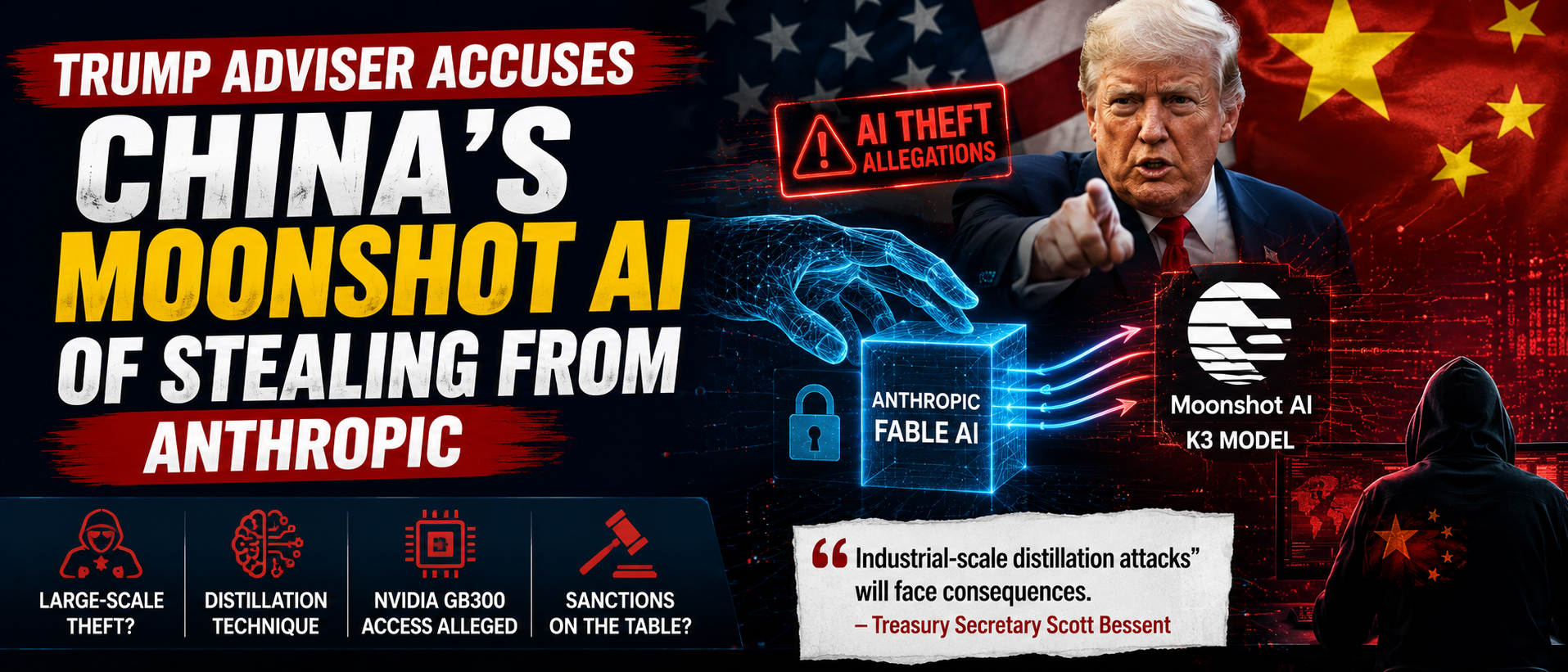
The allegations arrive at a sensitive moment in US-China technology relations, coming just a day after Treasury Secretary Scott Bessent said the US government was actively examining whether Chinese AI companies had been siphoning capabilities from American rivals. Bessent followed up on Wednesday by warning that sanctions would be considered against Chinese companies found to have crossed the line into what he called industrial-scale distillation attacks. He drew a clear distinction between open-source AI, which the administration supports, and what he characterised as treating that openness as permission to steal American intellectual property at scale.
The Accusations Against Moonshot and Its K3 Model
Moonshot's Kimi K3 model attracted widespread international attention after its unveiling last week, with many observers noting that it appeared to narrow the technological gap between Chinese and Western AI development. Moonshot itself claimed that K3 was capable of competing with the leading models produced by top American technology firms, a claim that drew both interest and scrutiny. Kratsios alleged that the capabilities Moonshot presented in K3 were partly derived from Anthropic's Fable AI through distillation rather than from original research and development.
Kratsios further alleged that Moonshot likely gained access to servers powered by Nvidia's GB300 Grace Blackwell computing platform to train its models. This is significant because Washington restricted the export of Nvidia's most advanced chips in 2022 precisely due to concerns that they could be exploited by the Chinese military. Since those restrictions were imposed, governments around the world have worked to crack down on the smuggling of restricted chips, making the alleged access to such hardware a serious additional dimension to the accusation. Moonshot AI, the Chinese embassy in Washington, Anthropic, Nvidia, and the White House had all been approached for comment at the time these claims were made.
Broader Context and What Comes Next
The accusations against Moonshot are not the first of their kind. In June, Anthropic accused Chinese technology giant Alibaba of illicitly extracting capabilities from its Claude AI models through similar distillation methods. At the time, Anthropic urged lawmakers to impose penalties on companies behind such attacks and to strengthen measures preventing American technology from being exploited by foreign competitors. The White House had signalled as early as April that it intended to work more closely with US AI companies to combat what it described as systematic foreign campaigns to undermine American research and development and access proprietary information.
The Chinese government had not issued a public statement in response to the latest allegations at the time of the announcement, though it has previously maintained that its AI development is the product of its own work and international cooperation rather than theft. Moonshot AI has announced it will release its Kimi K3 model as an open-source product on July 27, which would make it the first model of its scale available for free download and customisation by developers and the general public. The timing of that release, coming days after the distillation allegations surfaced, is likely to attract further scrutiny. The heightened focus on Chinese AI companies also comes as Trump is expected to hold a bilateral meeting with Chinese President Xi Jinping in September, adding a geopolitical dimension to what has rapidly become one of the most contested issues in the global technology landscape.