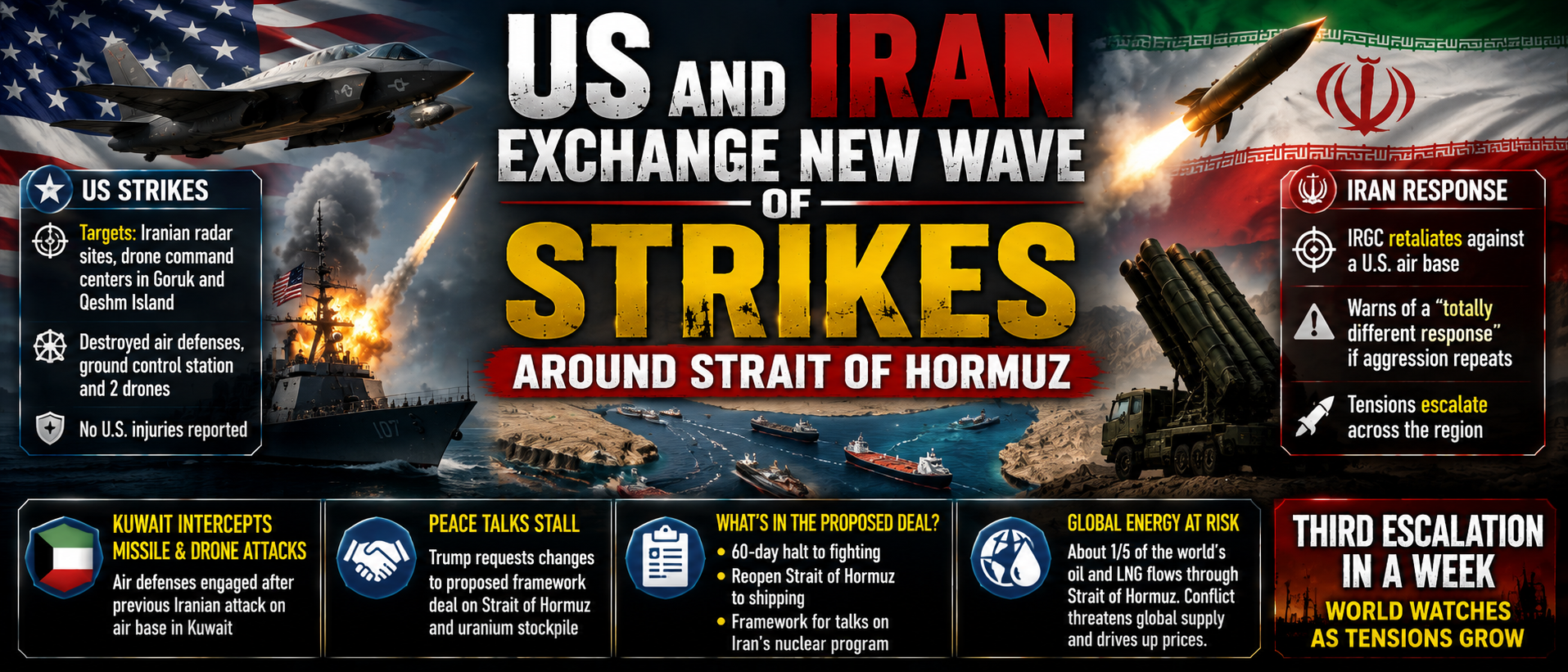
The US Military Said United States Central Command said its strikes were self-defence strikes carried out in response to what it described as aggressive Iranian actions, including shooting down an American drone over international waters. Centcom, in a statement posted online, said its forces had carried out strikes on Saturday and Sunday against Iranian radar sites and command and control sites for drones in Goruk, Iran, and on Qeshm Island. Military fighters struck Iranian air defence systems, a ground control station, and two drones, it said, posing a clear threat to vessels transiting through regional waters, the military said. No Americans were reported injured in the strikes.
Iran's Response and Warning
The Islamic Revolutionary Guard Corps said it had carried out a retaliatory strike against the air base from which the United States had launched its attack on an Iranian communications tower on Sirri Island in the Gulf, some 40 miles from Iran's southern coastline. In its response, Iran did not say where it hit an air base. It also delivered a pointed warning. The IRGC's response would be totally different if American aggression was repeated, the semi-official Fars news agency quoted the IRGC as saying, suggesting Tehran was ready to escalate further if the strikes continued. The incident is a sign of a major deterioration in security around one of the world's most strategically important waterways.
Kuwait Pulled Into the War
Kuwait's military also pointed to the regional fallout from the conflict, saying Monday it was dealing with hostile missile and drone attacks on its air defence systems. Kuwait did not say where the interceptions took place. The attack comes after an earlier incident in which Tehran targeted an air base in Kuwait in response to previous American air strikes, which the U.S. said had been carried out to prevent Iranian boats and missile units from laying mines around the Strait of Hormuz shipping channel. The involvement of Kuwait shows how the conflict between the United States and Iran is increasingly impacting neighbouring states in the Gulf region.
Peace Talks Bogged Down on Key Issues
The military exchanges are taking place in the context of stalled diplomatic efforts to reach a permanent settlement. A ceasefire came into effect on April 8, and Trump has repeatedly voiced optimism about the progress of negotiations, but no formal deal has been reached. Trump met Friday with top aides to make what was described as a final decision on a framework to extend the ceasefire, but the meeting ended without clarity on next steps. Later reports indicated that Trump had requested revisions to the draft of the agreement. The requested changes were apparently in relation to two of the most contentious issues in the negotiations – arrangements around the Strait of Hormuz shipping channel and the removal of Iran's stockpile of highly enriched uranium, American media said.
What's in the Proposed Deal?
The latest framework being proposed calls for a 60-day halt to fighting, a commitment to reopen the Strait of Hormuz to international shipping, and a framework for resuming talks on Iran's nuclear program. Iran's chief negotiator on Sunday said Tehran will not accept any deal unless Iranian rights are fully and completely ensured, a position that illustrates the great gap that remains between the two sides on key issues. The White House did not respond to requests for comment on the reported changes Trump had sought to the deal's terms.
Stakes of Global Energy
The closure of the Strait of Hormuz and military activity in the region have significant implications for global energy markets. Normally, about one-fifth of the world's oil and liquefied natural gas shipments pass through the Gulf shipping channel, and the effective trade embargo resulting from the conflict has put sustained upward pressure on fuel prices around the world. Every new round of military exchanges between the two sides adds more uncertainty to any prospects of a quick resolution, extending the disruption to global energy supplies and raising the cost to consumers and economies dependent on Gulf oil exports.