What Netanyahu Said
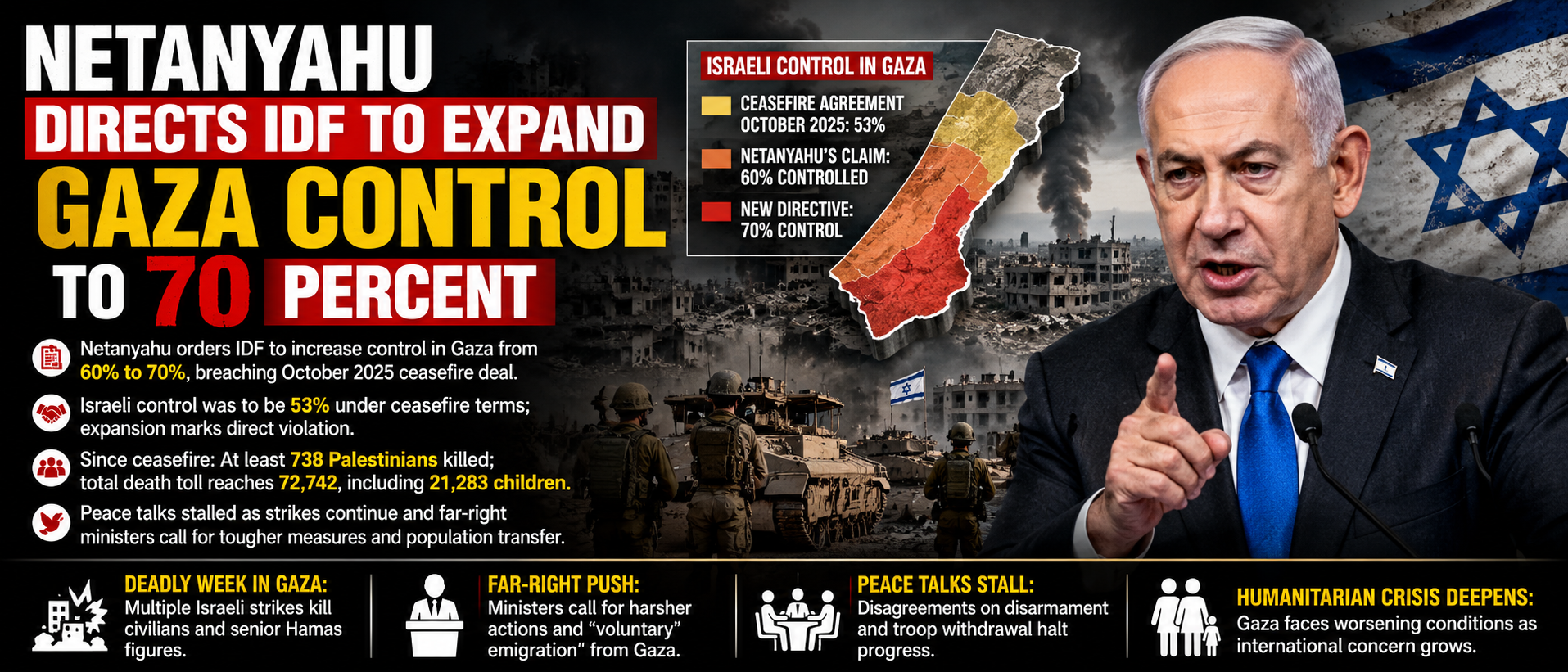
Netanyahu spoke at the conference and described the path of Israeli control of land in Gaza, where the army had gone from controlling 50 percent of the Strip to 60 percent, and his instruction now was to go to 70 percent. "In the crowd, someone called for 100 percent, and Netanyahu responded by suggesting that we take this process step by step, beginning with 70. T
he comments represent one of the clearest public acknowledgements by the Israeli prime minister that the IDF has been extending its presence in Gaza beyond the borders set out in the October 2025 ceasefire deal, under which Israel was to control roughly 53 percent of the territory after pulling back to a border known as the yellow line.
A Direct Breach of Ceasefire Terms
In October 2025, the United States, under President Donald Trump, brokered a ceasefire agreement that established a framework for the de-escalation of the conflict and conditions for a wider peace process. The deal would see Hamas disarm and Israeli troops withdraw from Gaza as the next steps of a 20-point peace proposal. But indirect talks between Israel and Hamas brokered by the United States have faltered, and Israel has carried on with its military operations in the territory even as the ceasefire is nominally in place.
Netanyahu's statement that Israeli control has grown from the agreed 53 percent to 60 percent, and has been ordered to go to 70 percent, is a radical departure from the promises made when the agreement was signed.
Increasing Palestinian Casualties
The ongoing military operations in Gaza have exacted a heavy human toll. The Hamas-run health ministry says that since the ceasefire came into effect in October 2025, at least 738 Palestinians have died, and the United Nations says it believes the figures to be reliable. The wider cost of the conflict that erupted after the Hamas-led attack of October 7, 2023, has been devastating. Gaza has seen 72,742 Palestinians killed and 172,565 injured as of May 12, 2026, with at least 21,283 children among the dead. Israel's military campaign was launched in response to an attack that killed about 1,200 people in Israel and took 251 others hostage.
Recent attacks and high-profile targets
This week has seen several major Israeli strikes on Gaza. Local hospitals said at least five children and five adults were killed in a strike on a Gaza City building late Wednesday. The Israeli military said it was targeting two senior Hamas officials in northern Gaza but did not name them. The strike appeared to have targeted Hamas battalion commander Imad Asleem, who was killed along with his teenage daughter.
The assault on Gaza City came a day after Mohammed Odeh, the newly appointed leader of Hamas's military wing, was killed in an Israeli strike along with his wife and two sons. Ihab Khrizim, who was described as the head of a Hamas network that transferred funds, and Mohammed al-Habash, a unit commander who was said to be involved in weapons manufacturing, were killed in earlier strikes in the week.
Far-right ministers demand more.
Hardline ministers in the Israeli government have called for an even more aggressive approach to Gaza. Israeli Defence Minister Israel Katz publicly wrote that Israel had pledged to wipe out everyone who masterminded the October 7 slaughter and that Hamas would not be permitted to rule Gaza either civilly or militarily. He also referred to what he called a plan for voluntary emigration from Gaza, saying it would be implemented at the right time and in the right way.
Far-right National Security Minister Itamar Ben Gvir and Finance Minister Bezalel Smotrich have previously supported the notion of voluntary migration of Palestinians from Gaza and re-settling the territory with Jewish citizens, a stance that human rights groups and international legal experts have described as forced displacement of civilians, a war crime under international law.
Peace Talks Stall
Indirect talks between Israel and Hamas to move forward on the broader Gaza peace plan have stalled, even with the United States as a broker. The two sides have failed to agree on the next steps outlined in the peace framework, including the disarmament of Hamas and the withdrawal of Israeli troops.
The combination of Netanyahu's directive to advance territorial control to 70 percent, the continuation of strikes, and statements from far-right ministers about the future population of Gaza suggest that Israel's military and political strategy is moving further away from, rather than closer to, the conditions required for a negotiated settlement. As the humanitarian crisis in Gaza deteriorates, the international community continues to follow the situation with grave concern.