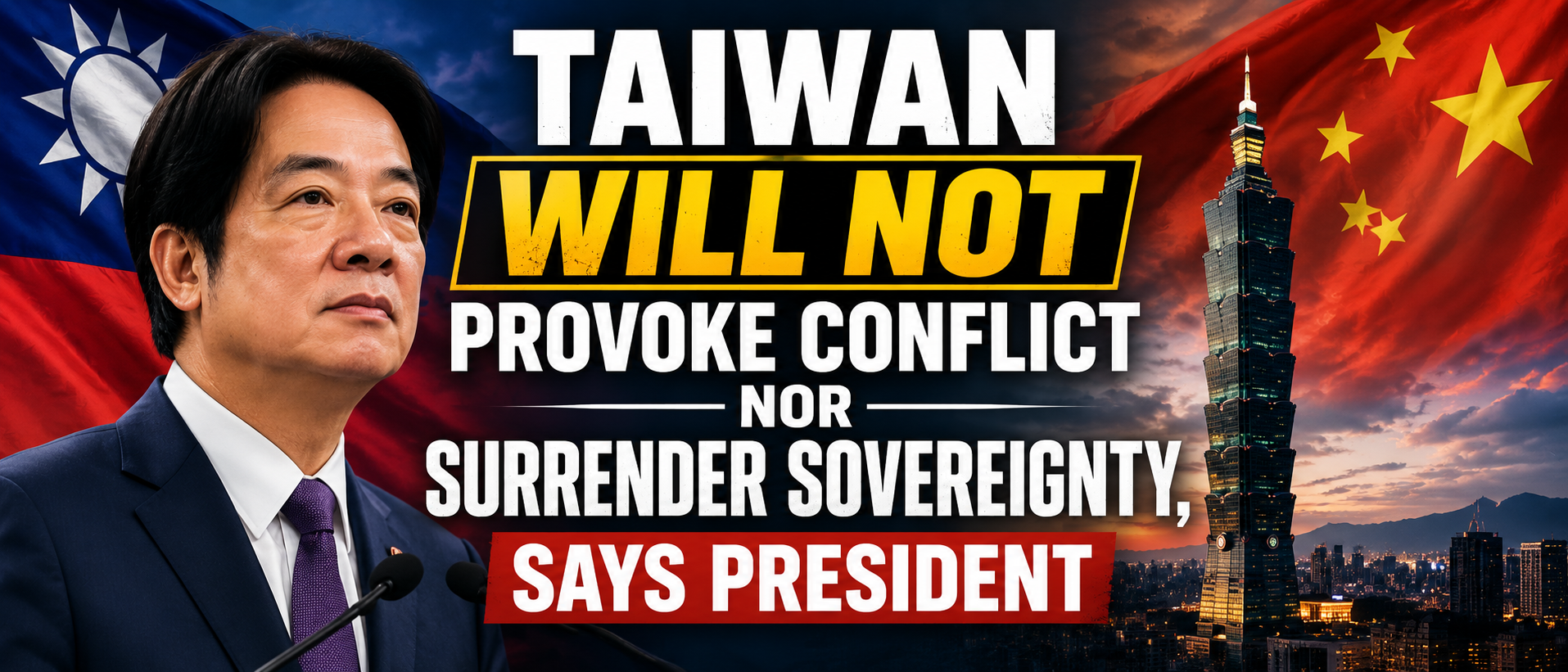
His comments followed signals from both Beijing and Washington that the Taiwan question had been discussed at great length during the Beijing meeting, prompting concern among Taiwanese citizens and officials about the course of American policy toward the island.
Xi tells Trump Taiwan is the most important issue.
Taiwan was the most important issue in the bilateral relationship of China and the United States, and mishandling it could lead to conflict, Xi Jinping told Trump during their summit, Chinese state media reported. The statement highlighted the importance of the Taiwan question in Beijing's foreign policy priorities and the importance that China attaches to the issue in its dealings with Washington. Trump, talking to reporters after leaving Beijing, said Xi had felt very strongly about Taiwan but gave no commitment either way on the issue.
Trump vows no policy change, warns
Trump told Fox News in an interview after the summit that he did not want to see Taiwan become independent, a remark that immediately drew attention for its possible impact on Washington's longstanding ties with Taipei. Trump also said U.S. policy on Taiwan had not changed, and he made clear he was not seeking a fight with Beijing.
That mix of reassurance and warning left a good deal of ambiguity about where the administration stands, especially in light of later comments suggesting that the decades-old commitment not to consult Beijing on arms sales to Taiwan may be subject to reinterpretation. Asked about that pledge, Trump said the 1980s was a long time ago.
Lai Reasserts Sovereignty of Taiwan.
President Lai also spoke at the summit in a Facebook post, his first direct public statement on the issue. He reiterated Taiwan's long-held position that there is no Taiwan independence issue, as Taiwan already views itself as a sovereign nation. "Taiwan, officially the Republic of China, is an independent and sovereign democratic nation," he wrote, "and its future must be decided by the will of the Taiwanese people."
Lai also said Taiwan is not a party seeking to change the status quo in the Taiwan Strait but has always been a defender of it. Tsai said Taiwan is willing to promote healthy and orderly exchanges and dialogue with China on the basis of equality and dignity but firmly rejected any attempt by Beijing to exploit the concept of unification as a tool to coerce Taiwan into dialogue on China's terms.
The Arms Sales Question
A key element of the post-summit period that will be watched closely is the future of U.S. arms sales to Taiwan. In December, the Trump administration approved a $11 billion arms package to Taiwan, one of the largest arms deals ever approved. But Trump told reporters aboard Air Force One that he would decide whether that sale would go forward, adding that he and Xi discussed it at length during their meeting.
The comments cast some uncertainty on a deal that Taiwan considers crucial for its defense. Lai thanked Trump for his continued support for peace in the Taiwan Strait and said ongoing American arms sales and deeper security cooperation between the two sides were necessary and a key factor in maintaining regional stability.
The stance of Beijing and the military pressure
China has repeatedly condemned President Lai, whom Beijing has branded a troublemaker and destroyer of cross-strait peace. Beijing continues to stress its preference for peaceful reunification with Taiwan but has not ruled out taking the island by military force. China has greatly increased its military activities around Taiwan in recent years, often conducting large-scale drills that have included blockade simulations to demonstrate its ability to cut off the island.
The Trump administration's approved arms package was strongly condemned by Beijing, which sees such sales as interference in an internal matter in China.
The Stakes for Taiwan's Status and the Rest of the Region
Most of the people living in Taiwan see themselves as nationals of a sovereign state, but many also want to maintain the status quo in cross-strait relations without moving towards formal independence or unification with China. The presidential spokesperson reiterated this position, saying Taiwan's status as a sovereign, independent, democratic country was self-evident, and reiterated the government's commitment to maintaining the status quo.
Today, with Beijing continuing to build its military capabilities and increasing the pressure on Taipei, and with questions being raised about the reliability and consistency of American support, the stakes surrounding Taiwan's role in the region arguably have never been higher.