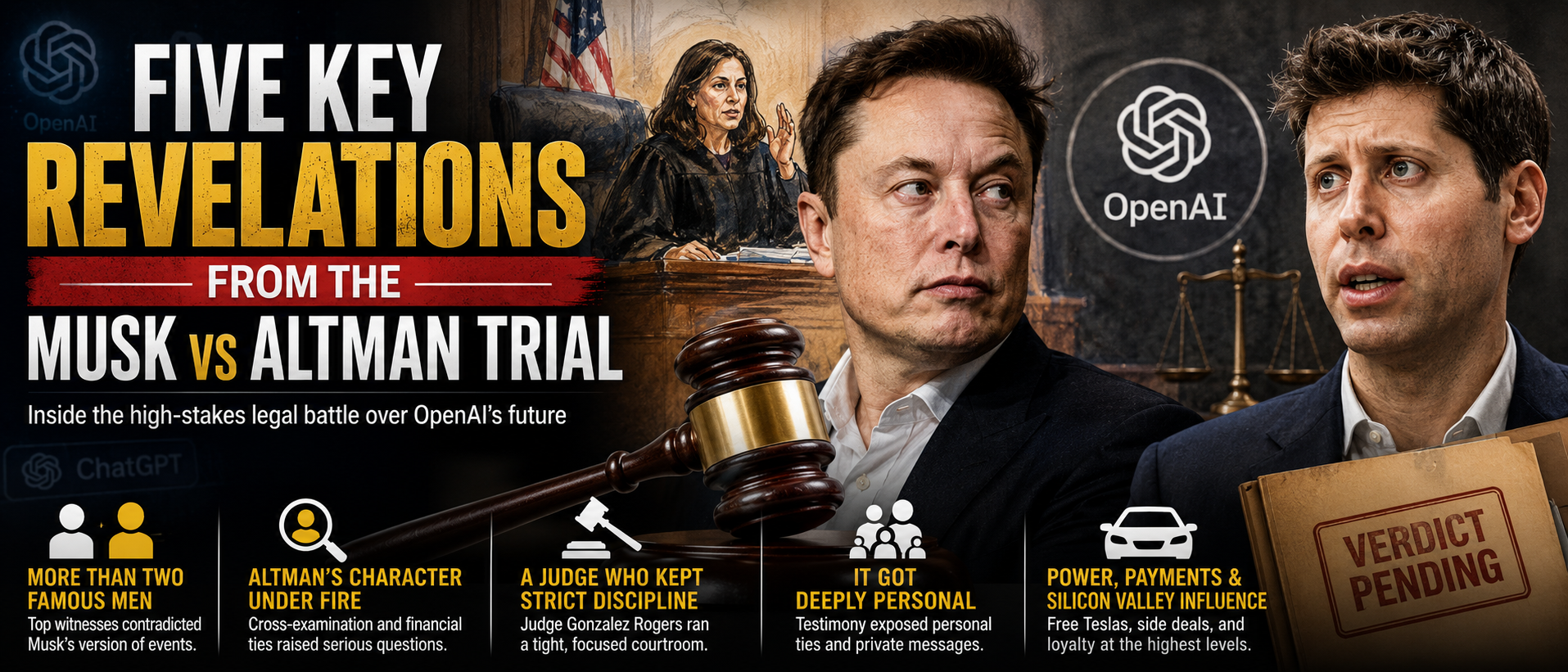
With the jury out deliberating and a no-nonsense federal judge mulling their decision before the final outcome, here are five of the most significant things the trial revealed.
It Was Far Bigger than Two Famous Men.
Musk's central claim is that Altman deceived him about OpenAI's commitment to remaining a non-profit organization, but the case quickly expanded well beyond a simple clash of two high-profile personalities. A parade of prominent witnesses testified they never saw any evidence of the commitment Musk claims was made.
Witnesses included OpenAI co-founder Ilya Sutskever, former OpenAI board member Tasha McCauley, and Microsoft chief executive Satya Nadella, whose company is also a co-defendant accused of aiding Altman's alleged scheme. Perhaps most strikingly, the trial featured a chorus of voices contradicting Musk's account of what happened.
Altman's character was heavily attacked.
Sam Altman received a high-profile endorsement from the witness stand, but that didn't protect him from a long, pointed interrogation about his personal character and professional conduct. In the weeks leading up to the trial, a highly detailed investigative profile portrayed Altman as someone prone to dishonesty, and Musk's attorney Steven Molo didn't hesitate to exploit that framing when cross-examining the OpenAI chief. Molo's initial question was simply to ask Altman if he was "totally trustworthy," which he answered hesitantly, and from then on, his credibility was a question mark throughout the entire proceedings.
Jurors also heard about Altman's large personal investments in private startups, some of which have entered into commercial agreements with OpenAI. His ties to the nuclear energy startup Helion Energy drew particular scrutiny because he was the company's board chairman and had a stake worth over $1.5 billion in a company that has not yet produced power.
The Judge Who Kept Strict Discipline.
Judge Gonzalez Rogers was one of the more memorable characters in the trial, presiding over the proceedings with a firm hand and little patience for rule-breaking. She maintained a rigid schedule, allowing herself only two twenty-minute breaks a day and no lunch, all in the name of maximum focus in the courtroom. She quickly chastised onlookers trying to take pictures of the proceedings or attorneys who wandered into areas she'd previously barred.
At times, her dry sense of humor came through, most notably when audio equipment failed early in the trial, and she noted the court is funded by the federal government. Courtroom sketch artist Vicki Behringer captured the drama of the proceedings in watercolor illustrations for those who couldn't see the trial in person.
It got deeply personal.
The trial was more than legal arguments; it focused the court's attention on some intensely personal dimensions of the relationships involved. Musk was largely combative on the stand, the first witness to testify, but visibly rattled when asked about his relationship with Shivon Zilis, a senior executive at his company, Neuralink. He said they lived together, and she was the mother of four of his children. Zilis herself testified that Musk offered her his sperm when he saw that she had no children while sitting on the OpenAI board. She later said she didn't tell her OpenAI colleagues about her ties to Musk until a media report was about to be published.
Messages attributed to Zilis also showed that she quit the OpenAI board as soon as Musk launched his own artificial intelligence company, telling a friend that there was nothing to be done when the father of your kids starts a competing business and starts poaching talent from your company.
Free Teslas, Side Payments, and Power in Silicon Valley
For those outside the tech industry, the trial offered a revealing glimpse into how influence and loyalty are managed at the highest levels of Silicon Valley. Musk's lawyers said he gave free Tesla cars to co-founders to keep their compensation low. Instead, Altman was accused of providing side payments to a crucial strategic partner in order to buy loyalty. Altman also said Musk suggested that his children take control of OpenAI.
Private text messages, used as evidence, stripped away the frantic and sometimes flippant nature of communications between these powerful figures, including Altman's nervous messages after he was suddenly fired from OpenAI in 2023, asking a former colleague if they still wanted him back. His replacement was described by the same colleague as some random executive from the gaming platform Twitch.
The billion-dollar stakes and surprisingly casual private communications painted a picture of an industry where enormous power is wielded in deeply human and sometimes messy ways. Now it's up to the jury, and ultimately Judge Gonzalez Rogers, to decide what happens next.