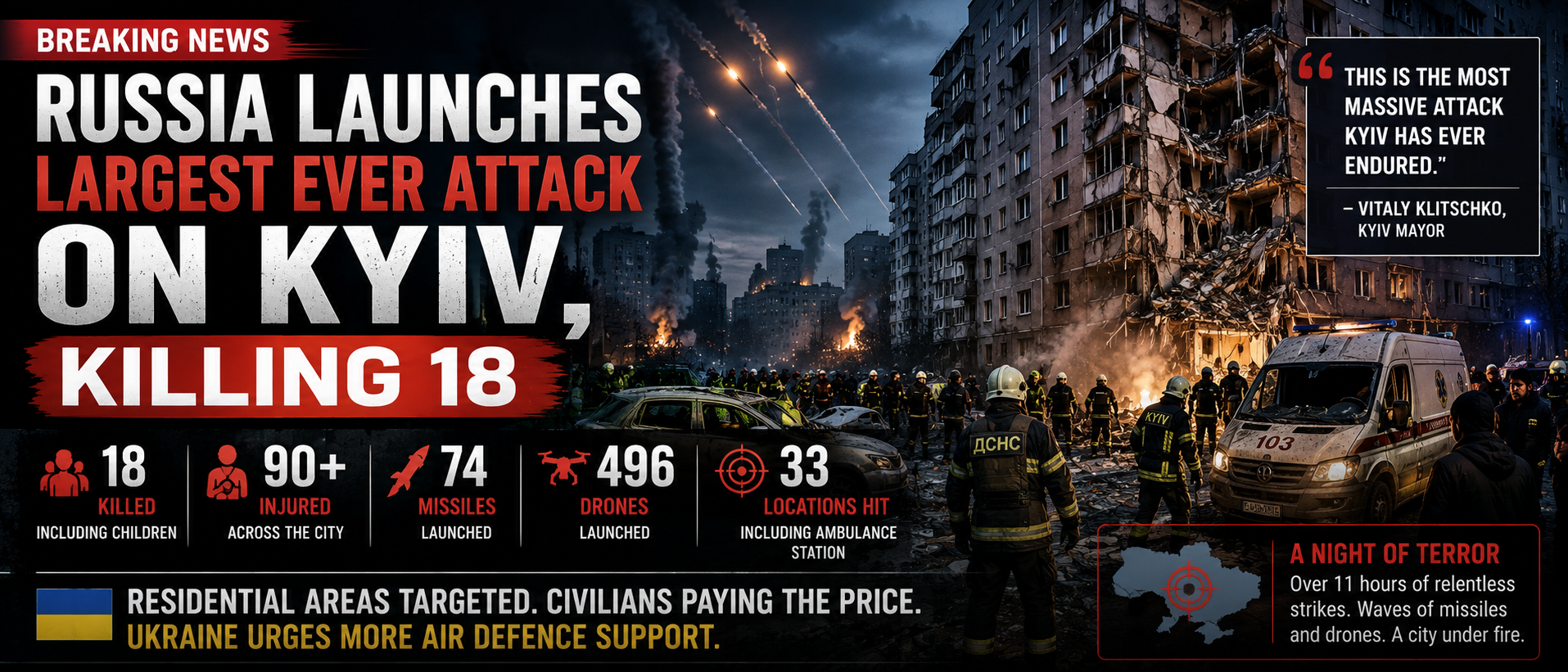
Ukrainian President Volodymyr Zelensky had warned hours before the strikes that Russia was preparing a major attack. The assault began with a drone strike on Kyiv's historic quarter, setting a hotel in the city centre ablaze. At around 01:00, dozens of ballistic and cruise missiles were fired in a concentrated wave. A short pause followed before another cluster of cruise missiles arrived around 03:00, after which a large swarm of drones targeted the capital right through until dawn. In total, Ukraine's air force confirmed that Russia had launched 74 missiles and 496 drones during the night, with the vast majority aimed at Kyiv. While Ukrainian air defences managed to intercept most of the incoming weapons, 25 ballistic missiles and 12 drones still struck 33 locations across the city, including an ambulance station.
Residential Areas Targeted, Civilians Bear the Brunt
The scenes on the ground told the story of an attack aimed squarely at civilian life. In the Darnitskyi district on the city's left bank in south-east Kyiv, two missiles landed in a residential area within steps of each other. The first left a large crater beside a kindergarten, gutting the surrounding buildings and twisting metal balconies beyond recognition. The second struck the end of a nine-storey residential block, causing a section of the building to collapse entirely into a heap of concrete. Cars were destroyed, windows shattered, and a thick layer of grey ash coated the streets and those working in them. Rescuers were digging through the debris to reach people potentially sheltering in the basement below.
In another part of south-east Kyiv, a high-rise apartment building had a section blown completely off its face. The city's military administration chief Tymur Tkachenko said the enemy was once again deliberately targeting residential areas and killing civilians. He confirmed that children were among the significant number of casualties. One resident named Svitlana told of hearing the explosions from her corridor during the air raid, describing it with a grim familiarity earned through years of enduring similar attacks — attacks that had previously cost her both her mother and her son. Another resident, Oleksiy, emerged with cuts and blood covering his face after being struck by flying glass when the second missile hit. He dismissed Moscow's stated justification for the assault outright, pointing out that what was hit was a residential area, not a military target.
Ukraine Calls for More Air Defence Support
Moscow claimed its forces had struck military plants in response to Ukrainian attacks on Russian civilian infrastructure, with Kremlin spokesman Dmitry Peskov warning that Russia would continue to increase pressure on what he called the Kyiv regime. Ukraine's foreign minister Andriy Sybiha described it as immoral to frame Russian strikes as a legitimate response to Kyiv's long-range operations, saying there was a clear distinction in this war between an aggressor and a country defending itself. Kyiv has in recent weeks carried out long-range strikes on Russian energy infrastructure stretching from the Moscow region to the Black Sea, which led to a rare admission by President Vladimir Putin that Russia was experiencing fuel shortages.
Ukrainian military experts described the overnight barrage as one of the most challenging the country's air defences had faced in months, with aviation analyst Bohdan Dolintsev noting that Russia's tactic of deploying multiple weapon types within the same time window was designed specifically to overwhelm and exhaust Ukraine's defensive systems. Zelensky used the aftermath of the attack to urge the United States to grant licences allowing the manufacture of Patriot air defence missiles, describing the supply of such systems as an absolute and critical priority. Sybiha added that Ukraine's partners needed to move beyond words of condemnation and take concrete action. Residents of Kyiv who have lived through more than four years of full-scale war noted that Russian attacks on the capital had changed in character over the past two months — arriving less frequently, but lasting longer, striking harder, and covering a wider area each time they came.