From the industrial back streets of Guangdong Province to the impressive exhibition halls of the Beijing International Trade Centre, the disparity between China's official picture of power and the private sadness being experienced by individuals on all levels could not be greater.
The Burden Falls Upon the Workers
The atmosphere amongst manufacturing employees in Foshan, the centre of manufacturing in Guangdong Province (and therefore China), is one of weariness and instability. Men who appear to be well past the age of 40 gather at local storefronts advertising temporary factory jobs available for an hourly rate of between 18 and 20 yuan ($3-$6). Temporary jobs consist of unskilled positions of basic assembly of plastic and other materials or parts for mobile phones. Many workers come from the rural provinces of China in search of income so they can send money back to their families.
They face not only the overall changes happening within China's economy, which is shifting from inexpensive low-cost production to more advanced technological manufacturing methods, but also the additional stress created by the global energy crisis caused by Middle Eastern wars. One worker also mentioned wanting to find work somewhere else because of so many people in his situation who have expressed a desire to seek employment with another company.
The Strait of Hormuz and Increasing Costs
China's energy reserves, along with its leadership position in alternative sources of energy and electric vehicles, have provided some protection from the devastating ramifications of the energy crisis created by the war. Unfortunately, this conflict has closed off the Strait of Hormuz, which is one of the most critical global shipping lanes through which a very large volume of oil is transported. This blockage of the Strait of Hormuz, by creating a significant increase in the cost of everything, is placing added pressure on the Chinese economy, which relies upon export trade for its success.
In Guangdong province, which has the largest fabric market in the world, many dealers are reporting a 20% increase in their costs because of higher oil prices. The fabric industry relies mainly on a consistent and inexpensive supply of petrochemical products, which are derived from oil, and the increased cost of raw materials is leading many foreign customers to reduce their orders for finished goods.
Some of these customers have decided to stop purchasing completed goods as a result of the increased price of finished goods. Since many Chinese dealers are already operating on very thin profit margins, they have to make the difficult decision of whether to increase their selling price of finished goods or absorb the cost internally within their business. Less Defiance, More Resignation:
Everything has changed in Guangzhou today compared to a year ago, when the United States and China were embroiled in a trade dispute. At that time, Guangzhou had a real feeling of defiance among the people who believed that China could withstand any amount of external pressure put on them. This has since changed, and the people now project a more resigned attitude.
The issue about the trade war and how to respond to it was one that China could respond to with policy tools and redirection of exports. But while China could manage the trade war, the current crisis in the Middle East is creating a much different type of challenge for them that has fundamentally altered the cost structure of manufacturing in China. This, too, will not be able to be managed through government intervention; instead, the workers and businesses appear to be accepting the circumstances with a very quiet sense of weariness rather than the more aggressive attitude that had been prevalent previously.
A New China at the Canton Fair
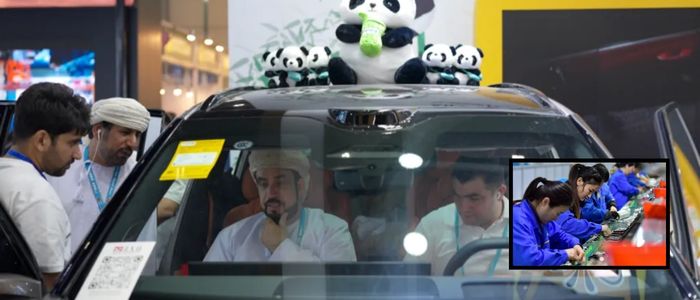
In contrast to the struggling fabric suppliers and transient workers here, a very different picture of China could be seen at the Canton Fair, the largest trade expo in China, which takes place in the expanse of exhibition halls in Guangzhou. Humanoid robots performed and waved to international guests, there were AI glasses that promised real-time translations, and robotic mobility aids attracted very long lines of customers who were intrigued by their design and application.
The Canton Fair serves as the embodiment of China that Beijing's authority would choose to convey to the world, a country looking ahead to invest in future technologies, while its biggest competitor (the U.S.) is involved in military action on another continent. There are different consumer products included to showcase the various products available to everyday consumers, including but not limited to high-quality vacuum cleaners, espresso machines, personal grooming items, etc.
The common denominator for traders was that all prices were trending upward for the many categories of products. Traders cited, among other things, the increase in the price of plastics (and other oil-based materials) used in manufacturing will be a large contributor to the upward trend of prices in the numerous products offered.
Electric Vehicles (EVs) are easily seen in the midst of the chaos caused by COVID-19 and the war in Ukraine, which has created greater demand for EVs in the production and exportation of the units. Since increased fuel prices have occurred all over the globe, consumers who cannot afford to operate their vehicle(s) on gasoline/diesel are purchasing EVs from Chinese manufacturers. The China Passenger Car Association data reported that Chinese manufacturers exported 350,000 EVs in March alone, which is equivalent to a 30% month-over-month growth from February and an incredible 140% year-over-year growth from March of the previous year.
The increasing demand for EVs from countries experiencing truly exorbitant fuel prices will significantly benefit China's export market, even if the market is disrupted by war. However, that level of growth in EVs is not going to be experienced by all traders at the same rate. According to Joyce Liu, an EV trader at the Canton Fair, since the war, her dealings with buyers from Middle Eastern countries have almost come to a complete standstill.
'She used to send 90% of her vehicles to Middle Eastern countries, but now there has been a halt in shipments. Now, cars are sitting at the port in China waiting to be shipped to other buyers. Joyce is actively searching for new buyers from Africa, South America, India, Bangladesh, and Turkey, and she has found several interested parties at the fair.
China's Diplomatic Balancing Act
China's response to the war has been very carefully planned out to try to promote a variety of different interests at the same time. China is calling for a ceasefire from the sidelines and quietly encouraging Iran to engage in peace talks. Meanwhile, Chinese President Xi Jinping is holding meetings and having phone calls with both the crown princes of the United Arab Emirates and Saudi Arabia. Many analysts believe this diplomatic activity is a staged attempt at showing that China is a relevant and serious global power, through its real commitment to the region.
William Figueroa, a professor of History and International Relations at the University of Groningen, stated that China is trying to flex its diplomatic strength both to the United States and to its regional partners. Yu Jie, an analyst from the London-based think tank Chatham House, has a slightly different view and believes that while the decline of the U.S. was something China always expected, the decline of the U.S. that China is currently experiencing is not at all what they expected. Yu believes that a predictable U.S. would be much easier for the Chinese to work with than the currently unpredictable U.S. Also, Beijing is actively trying not to provoke Trump ahead of a summit in May, and securing that meeting is currently a top priority of the Chinese government.
The Gap Between Ambition and Reality
China's increasing presence as a global economic and diplomatic force is becoming ever more visible to outside observers, but it means nothing to the workers of Foshan who are sitting in the backstreets just waiting for their next temporary contract to start. One worker produced his pass from the Canton Fair (this same event that showcased China's technological brilliance, an hour from the workers' location). He worked for 14 hours cleaning the facility for which he was paid 150 yuan (approximately $20). He laughed when he described his job while he continued to smoke another cigarette.
The gap between the picture of China being displayed in the well-lit exhibition halls and the picture of China being seen through the tired faces of Foshan's temporary workers is vast, and this war in the Middle East, for all of Beijing's diplomatic strategy, is doing nothing to narrow it.