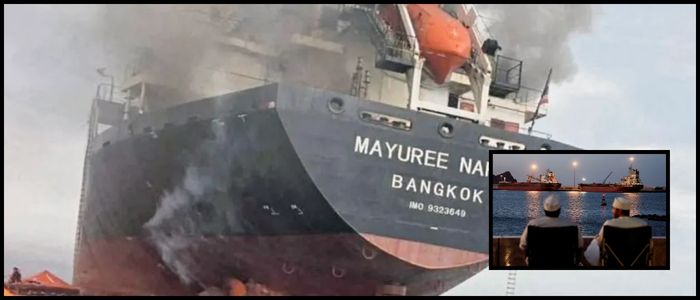
Crews are unable to conduct business as normal since oil tankers and cargo vessels cannot offload or receive cargo while they wait in ports or are anchored at sea. Many crew members are watching from their ships as missiles, drones, and fighter planes conduct military operations surrounding them. As a result, most crew members feel their typical routine voyages are at risk and have been turned into a long game of waiting.
A Pakistani sailor, using the name Amir for security reasons, said he had witnessed both drones and cruise missiles fly low across the waters of the United Arab Emirates close to the vessel on which he is working.
He went on to explain that the greatest fear of the crew members is the possibility of being hit by a missile or drone being shot down by an air unit before it crashes back onto the vessel. Another sailor from Myanmar, who was identified as Hein, witnessed planes in combat shooting at each other while his crew was working on the deck of the vessel on which he was located.
"There are no safe places on a ship," said Hein. "The only thing we can do is run inside the ship until the battle shifts away.
Industry associations estimate that as many as 20,000 sailors either cannot leave their ships or are awaiting to return home on their ships in the region. Some vessels have been left unable to leave the ports, while other vessels are stuck at sea waiting for the opportunity to safely travel through the Strait of Hormuz.
Captain Anam Chowdhury, who is the head of the Bangladesh Merchant Marine Officers Association, stated that several vessels have been damaged due to the conflict and that his organization has tracked at least seven vessels that have been hit by projectiles.
An example of a vessel that suffered damage would have been the world-registered vessel "Skylark". A sailor died on board Skylark (which is registered in the Republic of Palau) on 01 March 03 after being injured by a projectile that entered the tank.
Several of the survivors of the Skylark incident were traumatized after a fire broke out in the engine room of the vessel, forcing the crew to evacuate the vessel.
Disruption of Navigation and Communication
The ongoing conflict is impacting communication and navigation systems. There have been many reports from sailors of difficulties in receiving GPS signals and satellite communications, which are vital for safe navigation at sea.
Seo-jun, the captain of one of the vessels, stated that his vessel had to find its way into Dubai without the advantages of satellite navigation, which he described as "a blind person feeling for a doorknob" and was so difficult to find.
Many of the families of sailors are struggling to contact their families as well, particularly due to disrupted communication systems in and around Iran.
Rationing of Supplies
As vessels remain idle along their routes, there are many crews who are now becoming concerned about running out of food and water. Many vessels have implemented stringent rationing policies by limiting the meals provided to crews and greatly restricting the amount of drinkable water provided to crews.
According to a crew member, crews who used to have access to regular meals and fresh food are now receiving only small portions of meat and vegetables on a daily basis, and in many cases, supplies on those vessels will only last for a few more weeks.
Uncertain Future for Seafarers
It is also uncertain what will happen to the many seafarers when their vessels are finally able to arrive at a port of safety. There are many seafarers who will not be able to disembark from their vessels due to the arrest of their passports by the shipping companies. If the sailors abandon their contracts, they risk being blacklisted from future employment.
While waiting for a resolution, sailors feel powerless to change the situation and have expressed their feelings of being trapped in a conflict beyond their control.
According to Captain Chowdhury, the crews of the vessels are innocent victims of a larger geopolitical crisis.
"When you attack a vessel, you are attacking the crew on the vessel," he said. "Seafarers are not waging or participating in a war, yet they seem to be the ones who are stuck in the middle of it."