What's Behind the Selloff?
Charu Chanana, chief investment strategist at Saxo, described it as a "messy mix" of multiple overlapping shocks to the market, largely tied to the technology sector and exacerbated by higher energy prices. Technology stocks have been on a tear lately, but investors are repositioning as fears grow that the huge amount of money being poured into artificial intelligence may be greatly overvalued. "The burden of proof for technology companies has gone up substantially," Chanana said. "Investors are looking for more proof that demand for artificial intelligence has translated into actual revenue and not just speculation." Markets such as the Kospi and Nikkei, whose exchanges are heavily weighted toward technology stocks, are especially vulnerable to this kind of shock.
Market Slide Sets Tone
The sell-off in Asia on Monday followed a sharp drop on Wall Street on Friday, where a broad sell-off in technology stocks sent the Nasdaq down about 4 percent, its biggest one-day decline in more than a year. Part of Friday's decline was driven by concerns of a possible rise in United States interest rates, as a lower-than-expected unemployment rate for April, along with stifling inflation associated with the ongoing conflict in the Middle East, stoked fears that the Federal Reserve could tighten monetary policy further. That mix of domestic economic pressure and deteriorating Middle Eastern conditions provided a tough backdrop for risk assets as the new trading week got underway.
South Korean Tech Stocks Decline
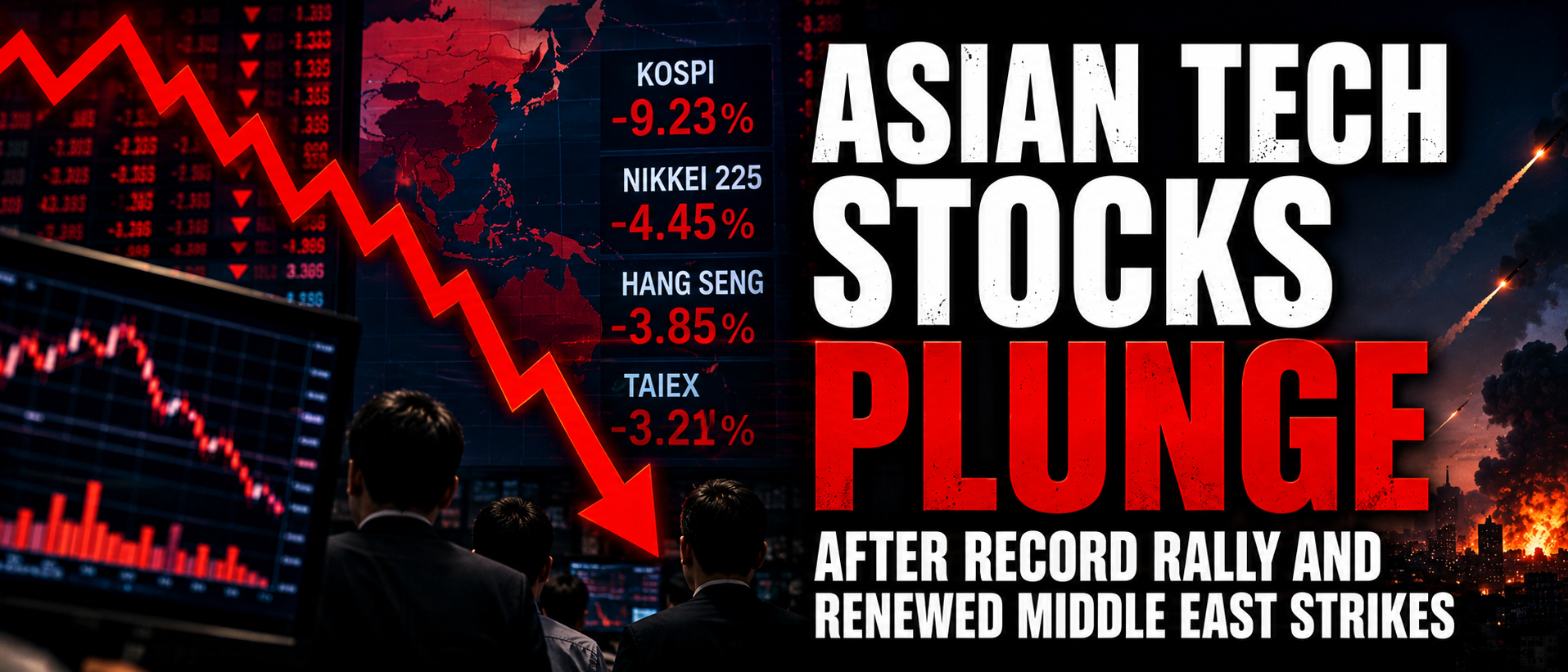
South Korea's Kospi index dropped about 7.9 percent in early afternoon trade after trading resumed following a circuit-breaker being lifted. Shares of large South Korean tech companies plunged, with Samsung and SK Hynix among the biggest hit by the chipmakers. South Korean President Lee Jae-myung admitted the stock market was volatile but said he thought domestic shares were still somewhat undervalued, providing some comfort for investors as losses piled up. The Kospi had rallied strongly in recent months on the back of a string of investments in South Korean tech companies, and the sharp turnaround was all the more jarring for investors who had positioned themselves for more growth.
Asian markets broadly pressured
The selloff was not limited to South Korea and Japan. Other major Asian markets also suffered heavy losses on Monday. The Hang Seng Index and the Shanghai Composite were both lower. Taiwan's Taiex sank after shares in semiconductor giant TSMC fell 3 percent. TSMC is a key supplier to Nvidia, whose chief executive Jensen Huang took a more upbeat view of the situation, saying the recent fall in technology stocks was a buying opportunity for investors willing to take a longer-term view of the sector's prospects.
Oil prices jump after Iran-Israel exchanges renewed.
Oil prices surged on Monday after Iran and Israel exchanged military strikes for the first time since a ceasefire was reached between the two sides and the United States in April, adding pressure on already jittery markets. Brent crude, the international benchmark, soared 4.6 percent to 97.34 dollars a barrel in Asian trading. US crude was up 4.3 percent to $94.40 per barrel. Tehran said the strikes were the start of a full week of military action and were in response to what it called a repeated violation of the ceasefire agreed on April 17. But despite a direct plea from United States President Donald Trump for restraint, Israel later retaliated against military targets in Iran. Trump told a news outlet that he thought a final deal with Iran was very close, and he did not want the emerging deal to be derailed by the escalating exchanges.
Diplomatic ambiguity and volatility in energy markets. Associate Professor Jiajia Yang of James Cook University in Australia cautioned it was too early to tell if the latest strikes were a full escalation of the war, but noted traders were again pricing in major risks to global oil markets. Yang said the strikes showed that many political issues are yet to be resolved and that oil prices are expected to be volatile unless diplomatic efforts succeed in stabilizing the situation. After the United States and Israel launched their first strikes against Iran on February 28, oil prices soared and then continued to fluctuate wildly during the subsequent ceasefire period. Traders found it hard to gauge the long-term impact of the conflict on global energy flows, with the war already disrupting the movement of oil and gas shipments from the Gulf after Iran threatened to hit vessels trying to pass through the strategically critical Strait of Hormuz, with prices hovering around the 95-dollar mark in the week before.